Over the Dump

St. Louisans talked back to the Department of Energy about nuclear waste last Thursday. But were the feds really listening?

by Richard Byrne Jr.

The Riverfront Times, Dec. 12, 1990

The Department of Energy came to praise nuclear waste and to bury it.

Well, OK. It’s already buried there. Close to 2.5 million cubic yards of low-level radioactive waste, scattered at three main sites in North St. Louis City and County.

It’s no news that the waste is here, and it was hardly a shock that 200 angry St. Louisans showed up Thursday at a ballroom in the Clayton Holiday Inn to tell the feds they didn’t want the stuff. What’s eye-opening is the leisurely pace at which the DOE wants to clean it up.

The DOE greeted suggestions that the United States stop producing nuclear waste and start cleaning it up with polite nods. After all, as DOE Deputy Assistant Director of Environmental Restoration John Baublitz stressed, the purpose of the hearing was to gather testimony on national strategies for cleaning up waste.

The atmosphere of the hearing was geared to minimize possible conflict. There was no give-and-take between the feds and those who testified. No arguments. Few, if any, tirades.

To further everyone’s “knowledge” of nuclear issues, a booth outside the ballroom stressed the benefits of nuclear material. There were pictures of astronauts. There were two cartons of strawberries — one zapped, one not zapped. (Which do you think looked better?) There were pictures of industrial and medical uses of radiation.

And then there was the “Radiation Quiz that also had a place on the booth.

One question was” Who receives more radiation exposure in a day? Underneath there were pictures of a nuclear worker and a skier.

Another question read: Which would you rather have drive past your home? This time there were a nuclear materials truck and a fuel truck.

There was even a “true or false” question: Radioactive materials have the best safety record of all hazardous materials shipped in the last 40 years.

If you haven’t guessed already, the answers are the skier, the nuke truck and “true.”

The questions, of course, are skewed. No one skis everyday, and radiation from the sun doesn’t seep into the water table. It isn’t often that petroleum trucks whiz by our homes. And 40 years isn’t that long a track record for the shipment of low-level nuclear waste.

Local activist Kay Drey called the quiz an outrage.

“They want to belittle low-level waste,” Drey says. “Low level waste is a term created by a genius on Madison Avenue. Some low-level waste can only be handled by remote control. To compare it to garbage is absurd. Volume is not the same as hazard.”

But there are people in the St. Louis area who live near and breathe the radioactive stuff. A generation of children in Berkeley played softball on a contaminated site. People like Gilda Evans, who brought her child — stricken with leukemia — to the microphone to testify with her.

“I live in cancer alley,” says Evans, who lives a few blocks from two sites. “How long are any of us going to be here with that stuff?”

Mel Carnahan was emphatic in stressing that hazard in our locality.

“No other metropolitan area in the nation has to contend with a radioactive-waste problem as potentially threatening as the one facing St. Louis,” the lieutenant governor said.

“2.5 million cubic yards of radioactive waste are stored by the United States Department of Energy (USDOE) in the St. Louis area. This is unacceptable in such a high population density.”

You might recognize some of the people who testified: Carnahan, County Executive-elect Buzz Westfall, Ald. Mary Ross (D-5), County Councilman John Shear (D-1). But there were a lot of people you wouldn’t recognize — mothers, students, teachers, businessmen.

Almost all of them had the same thing to say:

Don’t make any more waste. Get the waste that’s here in St. Louis cleaned up.
We’ve had nuclear waste in St. Louis since there was nuclear waste to have.

Back in the early 1940s, when the brilliant minds that came up with America’s atomic weapons program — the Manhattan Project — wanted to process the uranium and thorium needed for the bomb, they came to Mallinckrodt Chemical Works right here in St. Louis. In fact, the first nuclear waste for the Atomic Age was generated in the plant at Broadway and Destrahan.

In 1946, the War Department took over 21.7 acres of land near Lambert Airport through condemnation proceedings, and directed Mallinckrodt to store the hazardous byproducts of processed uranium and thorium there. Twenty years later, some of the waste was transported to a site on Latty Avenue in Hazelwood. Then in 1973, the airport site was deeded (through a quit claim deed) back to the city, after undergoing remediation that included a foot of clean dirt being poured on top of the wastes. The city was to use it as a police-training center.

Five years later, the Department of Energy sent out a news release saying that 26 sites — including the airport site and the Mallinckrodt site — required some form of remedial action.

Both were placed under the Formerly Utilized Sites Remedial Action Program (FUSRAP) in 1983 to be cleaned up.

Eight years later, it’s still sitting there. And it’s growing.

“In 1977, there was 50,000 cubic yards on contamination at Mallinckrodt,” says Drey, the most knowledgeable and passionate opponent of turning St. Louis into a dumping ground for radioactive waste. “In 1990, the latest estimates say 288,000 cubic yards of contamination, and that’s not including the buildings.”

The fight to get the sites cleaned up has lurched forward and back over the last eight years. The city’s Board of Aldermen voted unanimously in 1988 to ask the DOE to find a different place for the wastes. The Environmental Protection Agency placed the sites on Superfund, with the power to charge the owners of the land for cleanup costs. The Board of Aldermen then narrowly voted in January with the strong support of Mayor Schoemehl to donate 82 acres of land near Lambert to the DOE in exchange for indemnification against the costs of cleaning up the airport site. This would in effect, give the DOE carte blanche to “remediate on-site.” — in other words, to turn the place into a permanent storage site for the wastes with a practically eternal half-life.

Legislation introduced last year by Rep. Jack Buechner to get the wastes moved out of an urban area died in committee, and the EPA and DOE have entered into a Federal Facility Agreement that may or may not result in an on-site remediation of the wastes at Mallinckrodt, Latty Avenue and the airport site. A decision is not expected on that until 1994 at the earliest.

If a decision is handed down on the disposal of the radioactive waste at these sites in 1994, it will mean that 16 years will have elapsed since the feds first acknowledged the problem.

The 13 years that have elapsed so far have made a number of folks hopping mad, and they didn’t waste the opportunity to tell the DOE last Thursday night.

The hearing was not on St. Louis’ waste specifically, but on a DOE proposal to clean up contaminated sites in a five-year period. The Programmatic Environmental Impact Statement (or PEIS) was up for one of its two public-comment sessions, but St. Louisans were more interested in specific and immediate solutions. And as three representatives of the federal agency sat at a folding table, members of the crowd stepped up to the microphone and let the DOE in on some of the solutions they had in mind.

“The federal government is responsible for bringing this waste to St. Louis,” said Ald. Mary Ross. “They’re the only party technically and financially capable of cleaning them up.”

Ross also mentioned the strong votes against the permanent storage of radioactive wastes in the November referendums: 85 percent of the city’s voters expressed their wish that the radioactive wastes scattered throughout the northern part of the metropolitan area be taken elsewhere.

“The ballot spoke strongly,” Ross insisted. “The DOE is a powerful organization. You can encourage our congressmen not only to remove these wastes, but to appropriate the funds to do it.”

Bill Ramsey of the American Friends Service Committee stressed how the citizens had been kept in the dark about the nuclear policy of the United States.

“The U.S. government never consulted its citizens,” Ramsey said. “We need public discussion and public debate.” Later in his statement, Ramsey urged the DOE to “take the money we’re saving on weapons and use that money to clean up these communities.

Drey spoke of the nation’s energy policy and the clean-up process as “the emperor’s new clothes.”

“We still don’t know how to neutralize these wastes,” Drey said, urging the government to celebrate the first half-century of the Nuclear Age — due to arrive in 1992 — with a moratorium on the production of nuclear arms and waste.

Though there is a strong “not in my backyard” strain to the anti-waste sentiment that the DOE heard last Thursday, Drey prefers to think of it as a “not anybody’s backyard” movement.

“It’s not impossible to get it cleaned up,” Drey says, citing the government’s rapid cleanup of low-level waste near Salt Lake City. “We cannot leave it where it is.”

Sister Cities?

St. Louis Shares its nuclear waste — but not a lawsuit — with a Colorado town

by Richard Byrne Jr.
The Riverfront Times, July 24, 1991

Canon City, Colo., and St. Louis have a lot in common. A lot of radioactive waste, that is.
For the most part, it’s the same waste. Much of Canon City’s waste came from materials piled up in St. Louis during the 1940s and 1950s.

Like St. Louis’ nuclear waste, Canon City’s waste was moved to its current resting place a true estimate of the dangers to the public.

Like St. Louis’ nuclear waste, it’s creating fear — and perhaps illness — in those unfortunate enough to live near the Cotter Mill processing plant in Canon City.
Unlike St. Louis’ reaction to the waste, the folks in Canon City recently filed a class action suit.

It’s a suit that makes some startling allegations:

*Radioactive waste was carelessly shipped and spilled on the journey from St. Louis to Canon City. One carload of radioactive material was, the suit claims, “lost.”
*Traces of the waste from the uranium-processing plant near Canon City have been found in Arkansas River.

*The company that runs the plant — Cotter Corporation — has a long history of failing to meet state guidelines for the processing and storage of radioactive materials.
Cotter also had a hand in St. Louis’ radioactive contamination as well, when unbeknownst to regulators, it abandoned 8,700 tons of radioactive materials too weak to be reprocessed in the West Lake Landfill in St. Louis County at a depth of only three feet.

Can we learn something from the folks in Canon City?
In the past few years, St. Louisans have become acquainted with their nuclear waste. It’s about time, too. For years, St. Louis’ role in the dawning of the nuclear age and the risks associated with it were either underestimated, glossed over or, worse yet, kept secret.

But even now, as the U.S. Department of Energy (DOE) circulates its draft cleanup plans for the downtown Mallinckrodt Chemical Works, and as the U.S. Department of Health and Human Services issues a report calling the St. Louis Airport site (SLAPS) and Latty Avenue sites a “potential public health concern,” St. Louisans aren’t moving to gain significant input into the cleanup plans.

The residents of Canon City have taken their battle to court and sued the processors (Cotter Corporation and its parent company Commonwealth Edison) who brought the St. Louis 
Airport Cakes” to their town and the two railroad companies (Atchison, Topeka & Santa Fe and Santa Fe Pacific) who shipped it there.
the plaintiffs recently filed their fourth amended complaint in federal district court in Colorado.

“What we’re trying to do here is to get these companies to step forward and take care of their responsibilities,” says Lynn Boughton, a Canon City resident and one of the leading parties in the lawsuit.

The suit, which seeks a half-billion dollars in damages, charges the companies with , among other things, “negligence,” “willful and wanton conduct,” and “outrageous conduct.” The suit cites health risks to area residents, a precipitous drop in property values and the inaction of the defendants, even to this day, to take measures to improve the situation.

“No cleanup’s been undertaken yet,” Boughton says angrily. “Even after our suit’s brought all this to light. The only thing that’s happened is that (Cotter) has fenced the area.”

Cotter Corporation did not respond to RFT calls, but the lawsuit says that in a deposition conducted in February of this year, Cotter President (and Commonwealth Vice President) George Rifakes denied that there are carcinogenic materials at Cotter Mill.

The history of Canon City’s waste is inextricably tangled with St. Louis’ nuclear history — a history as long as the nuclear age itself.
In fact, the radioactive material that ended up in Canon city also resides at all four of St. Louis’ waste sites. The was was originally generated by the processing of uranium ores at the downtown Mallinckrodt plant from 1946 to 1956, and was stored at SLAPS for another 10 years.

In 1966 the Atomic Energy Commission (AEC) the precursor to the Nuclear Regulatory Commission (NRC), sold the residues to Continental Mining and Milling Corporation for $126,000.

Continental moved the materials to their site at 9200 Latty Ave. in Hazelwood. It was during this move that the haul routes along which the waste was moved were contaminated as well.

“The trucks that moved it weren’t covered or wetted,” says DOE spokeperson David Adler. “This move is what caused the haul-route contamination.

The stuff that Continental moved to Latty Avenue was residue from some of the highest-grade uranium available in the early 1940s — imported to the United States from the Belgian Congo.

“These materials were pretty hot stuff,” says local activist Kay Drey. It’s all the stuff that we still have out there. “

Continental went bankrupt a few years later, and that’s where Cotter stepped in, buying the residues, or raffinates, in order to dry them and ship them to its plant in Colorado to extract the remaining uranium. Cotter shipped these residues by rail to Canon City between 1970 and 1973.

According to the lawsuit, Cotter’s shipping [of the waste] was a disaster. Two of the railroad sites used to unload the raffinates are contaminated with hazardous radioactive waste. The lawsuit claims that is documentation of spillage of materials along the railroad tracks and that one “entire carload of uranium is unaccounted for.”
The suit also claims that public access to these sites was never restricted and that placards warning of radioactive material were never placed on the site.

If you think that’s bad, however, it’s nothing compared to what the lawsuit claims happened at Cotter Mill itself. The lawsuit claims that Cotter didn’t have a license to process the raffinates they shipped to Colorado and that two-thirds of the material was processed before Cotter notified the state. The suit also claims that some of the raffinates brought to Colorado were never processed and sit on the grounds, without cover and exposed to the elements. (Much of the St. Louis waste is covered with a tarpaulin, which has occasionally blown off.

The raffinates that were processed, the suit claims, have seeped into the groundwater, making their way to the nearby Arkansas River.
`Boughton, a chemist at Cotter until 1979, says that the company didn’t even tell its employees about the danger.

“No one told us what the isotopic content of this material was,” Boughton says. “We had processed a lot of the material when it came back to us through a lab that was following the material.”

What the material was full of, the suit claims, is thorium-230 and protactinium-231. Both are highly dangerous wastes, with measurable concentrations also present in the St. Louis’ piles. Boughton was later diagnosed as having lymphoma cancer — a cancer associated with thorium-230.

The lawsuit also lists a long series of citations of Cotter Mill — by the AEC and the state of Colorado — for non-compliance with license regulations, citiations dating back to 1959.

St. Louisans can feel bad for the residents of Canon City. they can even regret that it’s waste form the St. Louis area that has wreaked such havoc on their lives and property. But what relevance does Canon City case have for St. Louisans?

First, of course, is Cotter’s illegal dumping of 8,700 tons of radioactive waste at West Lake Landfill, near Earth City. A History of the St. Louis Airport Uranium Residues, prepared by Washington, D.C.’s Institute for Energy and Environmental Research (IEER), claims that Cotter dumped the waste “without the knowledge or approval…”

The IEER report also claims that the NRC has urged Cotter to “apply promptly for a license authorizing remediation of the radioactive waste in the West Lake Landfill.” The reports also says that Cotter has not yet taken any remeidal action.

But lawyers and activists insist that it’s not just the waste here in St. Louis that should turn local residents eyes to the Colorado lawsuit.

Louise Roselle, a Cincinnati lawyers who is aiding in the Colorado lawsuit, claims that the Colorado suit “is part of a growing amount of litigation in this country by residents around hazardous facilities.”

Kay Drey says that the Colorado suit is also interesting because of the research that’s being done on the materials that are contaminating Canon City.
“That’s basically the same stuff we have here,” Drey says. It’s just more splattered here — at a couple different sites.”

It’s the splattering effect in St. Louis that makes these sites more difficult to characterize and to remediate. The DOE is in the middle of the process of remediating a number of St. Louis sites — particularly SLAPS, Latty Avenue, and Mallinckrodt. But a record of decision —the DOE and Environmental Protection Agency’s official decision on what to do with St. Louis’ waste — is not due until 1994.

Drey says that St. Louisans need to keep the pressure on and take an interest in their nuclear waste.

“We need to let our leaders know that we want this stuff out of here,” Drey says. “What’s interesting about this lawsuit is that (Canon City) is looking into what it casn do with its waste.”

Poisoning the Workers

As a part of the Manhattan Project, Mallinckrodt developed a crude method of uranium purification using ether as a coolant. African pitchblende, which contained high concentrations of uranium, made up much of the crude ore the company then processed. The combination of extremely radioactive materials, wartime haste and lack of experience led to over-exposures among uranium workers here. Due to wartime secrecy, the workers weren’t given a clear indication of the dangers.

John Gofman’s Revelation

by C.D. Stelzer, the Riverfront Times, 1997

JOHN W. GOFMAN, a professor emeritus of medical physics at the University of California at Berkeley, has long contended that there is no safe level of radiation exposure. “I concluded it’s impossible for such a level to exist given the evidence on how radiation works,” says Gofman. The term “low-level radiation” is a political term used by the nuclear industry to lull the public into accepting exposure risks, he says. Similar phrases also downplay the consequences. “The terms `tolerance level,’ `allowable level,’ `permissible dose’ — those are all phenomenal words that are supposed to tell Joe Six-Pack, `Nothing to worry about — there ain’t no harm.’ That’s why these terms came into existence,” he asserts.

The 79-year-old Gofman is in a unique position to advise on such matters because he is a physician and holds a doctorate in nuclear physical chemistry. His research at Berkeley during World War II attracted the attention of J. Robert Oppenheimer, lead scientist in the Manhattan Project. After working on the atomic bomb at Oppenheimer’s request, Gofman completed his medical studies. But in 1969, Gofman fell from grace with the atomic establishment when he challenged the “acceptable” levels of radiation exposure then allowed.

After being ostracized by the atomic establishment for years, Gofman’s scientific opinions have been widely accepted of late. In 1990, for instance, after years of debate by U.S. scientists, a report by the fifth conference on the Biological Effects of Ionizing Radiation (BEIR V) concluded that radiation effects are proportional to dose in all cases. More recently, says Gofman, “The United Nations Scientific Committee on the Effects of Atomic Radiation said that the weight of evidence comes down on the side of no safe level. And the British National Radiological Protection Board in 1995 published a document in which they have now said that there can be no safe dose.”

Covering Up Human Radiation Experimentation

from  Riverfront Times reporting by C.D. Stelzer

Even as it denied the seriousness of nuclear fallout, the government was conducting secret experiments on radiation exposure. A 1986 congressional investigation headed by U.S. Rep. Edward J. Markey of Massachusetts found that, as a part of the Manhattan Project, American scientists injected unsuspecting patients with plutonium. Afterward, the surviving subjects weren’t informed of the experiment for more than 20 years, because the word “plutonium” was classified information during World War II. The list of these kinds of incidents is long.

Arthur Holly Compton Embraces the Bomb


The majority of the scientific and military community involved in the Manhattan Project remained true believers.

Physicist Arthur Holly Compton, the post-war chancellor of Washington University, became one of the most staunch defenders of Cold War diplomacy. In an open letter to U.S. Sen. Stuart Symington of Missouri, Compton wrote: “There are those … who believe that by arming our nation with the most effective weapons we are exciting the world toward war. My own appraisal of history is the reverse.”

Although acknowledging the dangers of nuclear fallout, Compton stood fast in his support of nuclear weapons testing. “In my judgment,” wrote Compton, “the hazard has in certain quarters been grossly exaggerated.”

Latty Avenue

Much of the radioactive waste that remains here is an unwanted by product of uranium purification conducted at the Mallinckrodt Chemical Works on North Broadway. In 1942, the St. Louis chemical manufacturer began refining uranium for the Manhattan Project, the secret wartime program to develop the atom bomb. The uranium used in the first atomic test explosion and the initial atomic attack on Japan was processed in St. Louis.

The first atom bomb used in actual warfare exploded over Hiroshima at 8:15 in the morning on Aug. 6, 1945. More than 100,000 people died, either instantly or of radiation sickness. The 2-kiloton bomb was nicknamed “Little Boy.” The  annihilation would be repeated three days later on Nagasaki. Japan quickly surrendered.

Whether the atom bomb attacks saved more lives by bringing a rapid end to the war is still a matter of great debate. President Harry S Truman, a Missourian, claimed that using the bomb prevented what would have been bloody land invasion that could have cost the U.S. a million more casualties.

This much is known, Japanese civilians who survived the attack on Hiroshima say they didn’t hear any noise at the moment the bomb detonated. Instead, they describe a blinding light, disintegration, darkness, and fire.

In short, hell on earth.

Borderline Crazy

Mallinckrodt radioactive waste generated in St. Louis ended up at the Lake Ontario Ordinance Works in upstate New York

Between 1944 and 1950, radioactive materials produced as part of the Manhattan Project by Mallinckrodt Chemical Works of St. Louis were secretly shipped to a site near Love Canal in New York state, according to a long-forgotten investigative story by the New York Times.

The contaminated site, ten miles north of Niagara Falls, was the original location of the Lake Ontario Ordinance Works. The Times published the details of the environmental quagmire in June 1980, more than 35 years ago.

In its investigative report, the Times revealed that more than 20,000 tons of radioactively contaminated materials were transferred from uranium refining operations in Townawanda, N.Y. and St. Louis in 1944 (see below excerpt from New York Times story). Mallinckrodt began purifying uranium for the first atomic bombs manufactured in World War II in March 1942, and continued the operations for 20 years during the Cold War.

Much of the uranium was known as Belgian Congo pitchblende, the purest form of the ore. During World War II, the Congo was still a colony of Belgium. Under an agreement with the U.S. Army Corps of Engineers, the Belgian-government-owned African Metals Corp. retained ownership of the valuable minerals found in the residue after processing.

Radioactive waste from Mallinckrodt is also known to have contaminated sites in St. Louis County, Mo.; Canon City, Col.; Fernald, Ohio and elsewhere. Before Mallinckrodt began its uranium refining operations it, it procured a waiver for all liability from the U.S. government.Niagara_2

NiagaraSTL

Nuclear Fallout

HISS

THE LEGACY OF HIROSHIMA EXTENDS DIRECTLY TO ST. LOUIS

BY C.D. STELZER

first published in the Riverfront Times (St. Louis), Aug. 2, 1995

Down at the end of the industrial court, where the concrete turns into a circle, a beige-colored, double-wide mobile home is parked between the Stone Container Corp. and Futura Coatings Co. The address, at 9200 Latty Avenue in Hazelwood, is landscaped sparsely with yews that have been manicured beyond salvation. On Saturday night, the trailer’s air conditioner hums even though nobody is there. Unpainted wooden steps lead to the door, as does a ramp for the disabled. A small gravel parking lot also includes handicapped-designated spaces.

For the most part, the site seems like any suburban-industrial park except for the small nuclear warning signs on the nearby cyclone fence. Behind the barrier is an imposing mound that juts over the surrounding one-story warehouses. The manmade hill is covered by grayish-black rocks and topped with a green net or tarp.

Although it is not identified as such, this radioactive waste site, which is now watched over by the Department of Energy (DOE), is a monument to the atom bomb attack on Hiroshima. Other contaminated locations that indirectly commemorate the origins of the atomic age are scattered across the St. Louis area, from the Mississippi River to Lambert Field and out to Weldon Spring in St. Charles County. They are dangerous reminders — twentieth-century vestiges of nuclear war.

Much of the radioactive waste that remains here is an unwanted byproduct of uranium purification conducted at the Mallinckrodt Chemical Works on North Broadway. In 1942, the St. Louis chemical manufacturer began refining uranium for the Manhattan Project, the secret wartime program to develop the atom bomb. The uranium used in the first atomic test explosion and two subsequent military strikes against Japan was processed in St. Louis.

The first atom bomb used in actual warfare exploded over Hiroshima at 8:15 in the morning on Aug. 6, 1945. More than 100,000 people died, either instantly or of radiation sickness. The 2-kiloton bomb was nicknamed “Little Boy.” The atomic annihilation would be repeated three days later on Nagasaki. Japan quickly surrendered.

“This much is known, Japanese civilians who survived the attack on Hiroshima say they didn’t hear any noise at the moment the bomb detonated. Instead, they describe a blinding light, disintegration, darkness, and fire.

“In short, hell on earth.”

Whether the atom bomb attacks saved more lives by bringing a rapid end to the war is still a matter of great debate. President Harry S Truman, a Missourian, claimed that using the bomb prevented what would have been bloody land invasion that could have cost the U.S. a million more casualties. This much is known, Japanese civilians who survived the attack on Hiroshima say they didn’t hear any noise at the moment the bomb detonated. Instead, they describe a blinding light, disintegration, darkness, and fire.

In short, hell on earth.

Photographs of the aftermath show miles of charred rubble. Many survivors bore terrible burns. The estimated heat generated by the bomb blast was four times as hot as the interior of the sun. The Hiroshima explosion could be seen from a distance of 250 miles.

The Manhattan Project cost the U.S. taxpayer about $2 billion. The subsequent nuclear arms race with the Soviet Union skyrocketed the into the trillions. In the rush to produce nuclear armaments, expedient means took precedence over safe disposal of radioactive waste. Generations of future Americans will be strapped with the expensive task of mopping up. The Department of Energy (DOE) now estimates the tab at more than $100 billion. By the end of the Cold War, there were 14 active nuclear weapons facilities in the U.S., occupying more than 3,350 square miles. The DOE has counted 8,700 radioactive and chemical dump sites nationwide that need remediation.

As a part of the Manhattan Project, Mallinckrodt developed a crude method of uranium purification using ether as a coolant. African pitchblende, which contained high concentrations of uranium, made up much of the crude ore the company then processed. The combination of extremely radioactive materials, wartime haste and lack of experience led to over-exposures among uranium workers here. Due to wartime secrecy, the workers weren’t given a clear indication of the dangers.

After the war, production at Mallinckrodt continued. Safety measures increased, but so did the waste. The legacy in St. Louis now amounts to 2.3 million cubic yards of radioactive material. Much of that unwanted stockpile is still untreated.

At the Mallinckrodt plant on North Broadway, for instance, the radioactive levels in some buildings still exceed what is now considered safe by the DOE. Earlier efforts to clean up the site only served to spread the waste. In the decade following the war, the federal government secretly moved hundreds of tons of radioactive waste and debris from the chemical factory to a 21.7-acre site north of Lambert Field. In the process, truck routes, ground water and surface water all became contaminated. Later, efforts to reuse some of the radioactive material resulted in the dump site on Latty Avenue. From there, some waste was illegally hauled to the West Lake landfill in Bridgeton. In addition, at least 5,000 truckloads of radioactive waste were transported to a quarry near Weldon Spring. By 1957, the AEC had opened a new uranium processing plant there.

Mallinckrodt operated the facility for the next ten years. It, too, became radioactively contaminated. Unlike the sites in St. Louis County, however, a DOE cleanup of the quarry and nearby plant is now underway.
A 1981 study of more than 2,000 Mallinckrodt uranium division workers showed an increase in three different cancers, including a 24 percent above-normal rise in the rate of leukemia . In addition, a controversial a series of cancer cases has plagued one block of Nyflot Avenue, a residential street in North County, a dump route where radioactive waste was spilled. In 1993, the Missouri Department of Health (MDOH) ruled the cancers on Nyflot were probably not related to radioactive exposure. But some environmentalist doubt MDOH’s conclusion.

The consequences of living with the emotional fallout from the bomb raises other concerns. Denial, rationalization and other psychological defense mechanisms have been a means by which responsible politicians, military leaders and the public at large have been able to cope with the sheer magnitude of the carnage that ended World War II, as well as the ensuing threat that it could happen here.

“As a cultural historian, … it seems to me that the prospect of a nuclear war, — evidence of the destruction of two cities — had a profound effect psychologically, often in ways that (we) didn’t recognize,” says historian Paul Boyer, a professor at the University of Wisconsin at Madison. Boyer, the author of Bomb’s Early Light, a cultural history of the nascent atomic age, believes the bomb undermined an essential sense of continuity in American society. “Much of American culture … since the period from 1945 really has to be understood in terms of this underlying anxiety and sense of uncertainty,” says Boyer.

Secrecy and deception added to the unease. After the war, the federal government embarked on a campaign to misrepresent the potential hazards of radioactive fallout, Boyer says. “The Eisenhower cabinet … said we’ll just confuse the public, … (and) say there’s no danger — people don’t understand these scientific complexities, anyway. … They didn’t know what they were doing. There were terrible poisons being pumped into the air,” says Boyer.

Today, there is ample evidence that public distrust of the government was warranted. In the post-war years, approximately, 250,000 combat troops were placed in close proximity to above-ground nuclear test blasts in Nevada and Utah to simulate possible wartime conditions. As a result, soldiers were exposed to as much as 12 billion curies of radiation, or 148 times more than was released from the 1986 Chernobyl nuclear accident in the former Soviet Union. Untold numbers of civilians, who lived downwind from atmospheric testing, were also exposed. Recently, Congress belatedly passed legislation granting $50,000 to civilians who can prove they got cancer after being subjected to radioactive fallout from the atmospheric nuclear test that occurred between 1951 to 1963. The Committee of International Physicians for the Prevention of Nuclear War estimates fallout from weapons testing has caused 430,000 additional cancer deaths in the last 50 years.

Even as it denied the seriousness of nuclear fallout, the government was conducting secret experiments on radiation exposure. A 1986 congressional investigation headed by U.S. Rep. Edward J. Markey of Massachusetts found that, as a part of the Manhattan Project, American scientists injected unsuspecting patients with plutonium. Afterward, the surviving subjects weren’t informed of the experiment for more than 20 years, because the word “plutonium” was classified information during World War II. The list of these kinds of incidents is long.

By early 1945, Leo Szilard, a Hungarian-American physicist, had begun circulating a petition among colleagues that implored the government not to use the atom bomb on Japan and keep it a secret. Well over 100 scientist signed the pact. By the time the appeal reached the White House, however, Truman had departed for the Pottsdam Conference in Europe, but not before Gen. Leslie R. Groves, the Manhattan Project director, had convincingly argued in favor of using the bomb.

The scientists who foresaw the dangers of atomic weapons were far from alone. The military leaders who raised questions or opposed dropping the bomb on Hiroshima included Gen. George C. Marshall, Gen. Dwight Eisenhower, and Adm. William H. Leahy. Yet the majority of the scientific and military community involved in the Manhattan Project remained true believers.

Physicist Arthur Holly Compton, the post-war chancellor of Washington University, became one of the most staunch defenders of Cold War diplomacy. In an open letter to U.S. Sen. Stuart Symington of Missouri, Compton wrote: “There are those … who believe that by arming our nation with the most effective weapons we are exciting the world toward war. My own appraisal of history is the reverse.” Although acknowledging the dangers of nuclear fallout, Compton stood fast in his support of nuclear weapons testing. “In my judgement,” wrote Compton, “the hazard has in certain quarters been grossly exaggerated.”

Compton had won the 1927 Nobel Prize for his work on X-Rays, which he did while the head of the physics department at Washington University. Later, at the University of Chicago, he became involved in overseeing work being done there on the Manhattan Project. As a part of that role, Compton came to St. Louis in April 1942 and asked chemical tycoon Edward J. Mallinckrodt, to help purify large quantities of uranium needed for the project. Three months later, Mallinckrodt Chemical Works was cranking out a ton of purified uranium daily. By December 1942, a team of scientists at the University of Chicago, led by Enrico Fermi, had generated and controlled the first nuclear chain reaction.

During his post-war tenure as chancellor at Washington University, Compton attracted nuclear scientists such as Arthur C. Wahl and Joseph W. Kennedy, two of the discoverers of plutonium. Kennedy died at age 40 of cancer, only two years after he and his partners had sold the rights to the plutonium separation process to the AEC for $400,000.
After witnessing the first atomic test explosion at Los Alamos, N.M. on July 16, 1945, another leading physicist — J. Robert Oppenheimer — recited an ancient Sanskrit verse from the Bhagavad-Gita, the Hindu holy book. “I am become death, the shatterer of worlds,” said Oppenheimer. Less reverently, his test director Kenneth Bainbridge responded to the atomic explosion by saying, “We are all sons of bitches now.”

Following the detonation over Hiroshima less than a month later, Robert Lewis, the co-pilot of the Enola Gay, the B-29 bomber that dropped the bomb, gazed at the inferno below and exclaimed: “My, God, look at that son of a bitch go!” , Later, Lewis revised his reaction in his journal by writing, “My God, what have we done?”

That question obviously entered the mind of Secretary of War Henry L. Stimson. Two days after the Hiroshima bombing, Stimson had a heart attack. He resigned soon after the Japanese surrender. In a February 1947 Harper’s magazine article, Stimson defended the decision to drop the bomb, but nonetheless warned of its grave consequences.

“The face of war is the face of death,” wrote Stimson. “War in the twentieth century has grown steadily more barbarous, more destructive, more debased in all its aspects. Now, with the release of atomic energy, man’s ability to destroy himself is very nearly complete. The bombs dropped on Hiroshima and Nagasaki ended a war. They also made it wholly clear that we must never have another war.”

Fly Me to the Moon

Screen Shot 2015-12-01 at 10.41.26 AM

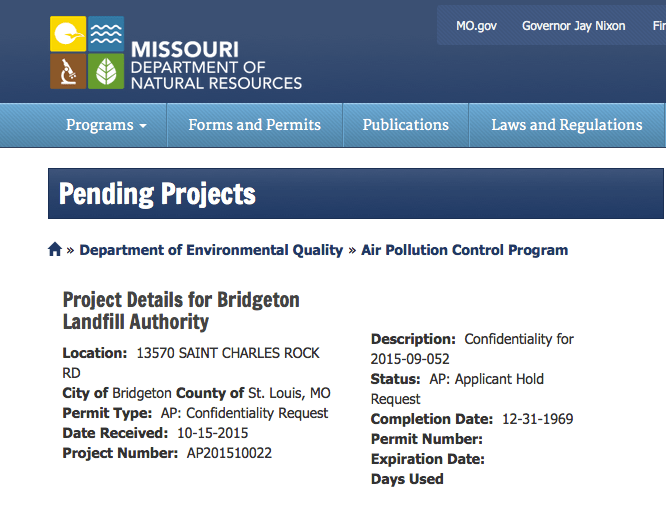
What’s up at the West Lake Superfund site? It’s anybody’s guess. The official operational status of the smoldering landfill at the site has been in limbo for months.  The extent of the ambiguity and accompanying confusion is reflected at the Missouri Department of Natural Resources website, which indicates the Bridgeton Landfill project at the site was completed mere months after the first men landed on the moon.

The unfortunate reality is that cleaning up Manhattan Project radioactive waste at West Lake and other sites in the St. Louis area remains incomplete 46 years after NASA’s successful Apollo 11 lunar landing.


bridgeton-landfill-permit-pending.jpg