Hot Wheels

When cyclists spin their wheels this weekend to commemorate the illegal dumping of  radioactive waste at West Lake Landfill, they’ll be riding over a very hot roadbed. 

screen-shot-2016-09-16-at-22-26-12

The Latty Avenue roadbed in Hazelwood, Mo. is constructed of highly radioactive nuclear weapons waste, according  to an overlooked Department of Energy document uncovered this week by the Environmental Archives.

Just hot is it under Latty?

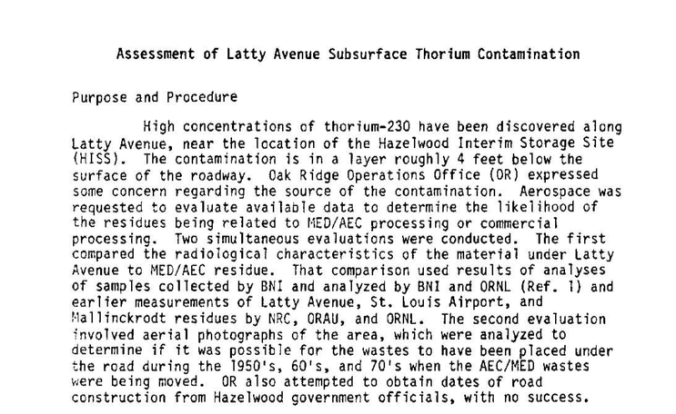
In 1987, Aerospace Corp.,  a DOE contractor, reported the levels of radiation in one hot spot under Latty Avenue were literally off the charts.

“Activities in the “hot spot” sample were so high that quantitative determinations using initial analytical techniques were not possible, and further analyses (sic) will be required,” according to the then-DOE contractor.

screen-shot-2016-09-16-at-22-04-13

The online database released the revelation along with a cache of other records obtained through the Freedom of Information Act.

The release of the document coincidentally corresponds with a planned ride by  bicyclists this Saturday to draw attention to St. Louis’ longstanding radioactive waste problem.

Tons of radioactively-contaminated materials at the Latty Avenue site were transported and illegally dumped at the West Lake Landfill in 1973 over a three-month period.

More than four decades later, the waste is still there, which has led in recent years to a fight by community members to get the EPA to relinguish control of the site to the U.S. Army Corps of Engineers.

The Corps has cleaned up the former storage area on  Latty Avenue and other sites in the St. Louis area as a part of the Formerly Utilized Site Remedial Action Program (FUSRAP).

But the haul route contamination, for the most part, has not been addressed  because it allegedly falls below the current clean-up standards set by the Corps. Radioactive contamination that lies under the pavement is now deemed as safe.

screen-shot-2016-09-16-at-22-29-27

In 1987, it was a different story, however, according to the DOE report made public by the Environmental Archive. At that time, the Aerospace Corp., a DOE contractor, expressed concerns over the high levels of Thorium 230 used to construct the Latty  Avenue roadbed.

The report concludes that the radioactive materials used to build the road in the 1960s or 1970s most likely came from processing waste generated by the Mallinckrodt Chemical Works of St. Louis under contracts with the top secret  Manhattan Project and later the Atomic Energy Commission. Analysis revealed that the high levels of Thorium 230 were evidence that the radioactive contamination was a byproduct of Congolese pitchblende, which is known to be the hottest uranium ore on the planet.

The pitchblende refined by Mallinckrodt was used to build the first atomic bombs.

screen-shot-2016-09-16-at-22-35-33

screen-shot-2016-09-16-at-21-56-45

The Uranium Cookbook

The EPA’s recent tests of West Lake nuke waste are not unprecendted. Sixty-five years ago the AEC published a recipe by Mallinckrodt Chemical Works  on “roasting”  pitchblende. 

Screen Shot 2016-07-21 at 08.02.39

“If you can’t stand the heat, get out of the kitchen” is President Harry S Truman’s  most noted quip. But Truman is remembered more for actions than words.

He ordered the atomic bomb attacks on Japan that ended World War II. Much of the uranium used in those bombs came from African pitchblende ore and was processed by Mallinckrodt Chemical Works of St. Louis. The classified work continued during the Cold War nuclear arms race that followed. As a result, radioactive waste was haphazardly strewn at sites across the region for 20 years.

Embers of that fateful era are still burning today in North St. Louis County, where leftovers from the Manhattan Project remain a topic of heated discussions.

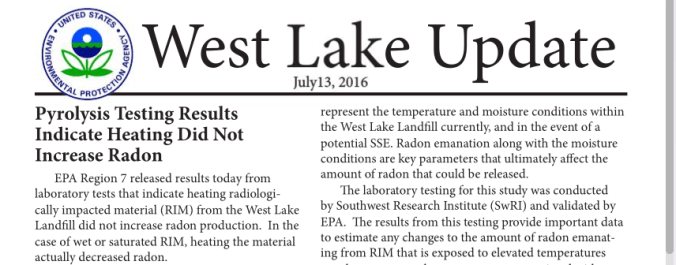
“Heat” is exactly what the Southwest Research Institute in San Antonio applied in its laboratory experiments earlier this year. The purpose of research was to determine whether uranium waste from the makings of the first atomic bombs — dumped decades ago at the West Lake Landfill — threatens to release harmful radon gas if exposed to increased temperatures.

Spurred by public concern, the EPA commissioned the study to see what would occur if the underground fire raging at the adjacent Bridgeton Landfill met the radioactively-contaminated materials (RIM) buried at the West Lake Superfund site. The question has been smoldering since December 2010, when landfill owner Republic Services reported the hellish conditions.

Screen Shot 2016-07-21 at 08.26.59

The good news, according to the EPA, is that the tests confirmed that baking RIM does not increase radon gas emissions and in some instances decreases them. Community activists have hotly contested those findings, questioning whether the simulated laboratory conditions are comparable to the real fire in the hole.

The latest assurances appear to be another attempt to stem the firestorm of public distrust that surrounds the topic.  Meanwhile, the subterranean smoldering event, as the EPA prefers to call it, continues to burn closer to the RIM.

As the sparks from this drama inevitably create more smoke than light, it should be kept in mind that the flouted tests are not the first to measure the effects of heat on pitchblende. That distinction goes to the Atomic Energy Commission, which published a Mallinckrodt report on the subject in December 1950.

The title of the 65-year-old tract, “The Roasting of Pitchblende Ore,” seems more applicable to a macabre cookbook than a scientific treatise. It also conjures up a combination of Arthurian alchemy and biblical fire and brimstone.

Brimstone is the ancient word for sulfur.

Up to ten percent of the content of the pitchblende ore was comprised of sulfur, according to the Mallinckrodt study. In the 20th Century, the Mallinckrodt scientists were not concerned about the health impact of the sulfur or radioactive materials for that matter. Instead, they theorized that removing the sulfur by cooking the pitchblende would save the company money and increase profits.

Screen Shot 2016-07-21 at 13.00.02


What Nobody is Saying

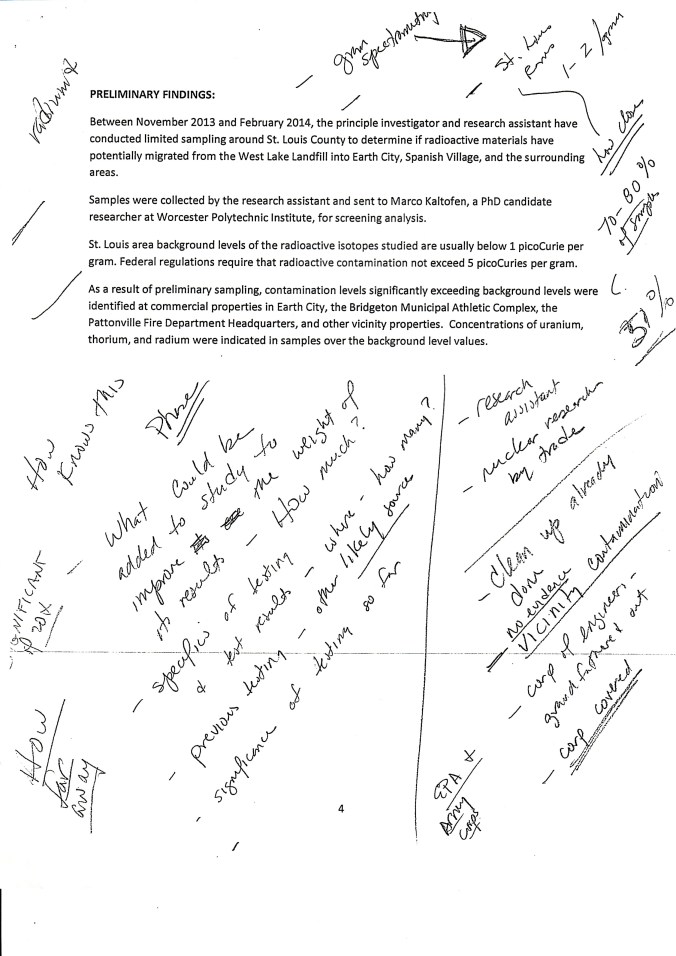
Notes obtained by StlReporter Say West Lake Nuke Waste is Present at Previously Undisclosed Locations.

Notes on the preliminary findings of  independent sampling conducted in 2013 and 2014 indicate that above background levels of radioactive contamination were discovered at multiple locations in St. Louis County, including the Bridgeton Fire Protection District.

Neither those involved in the testing or the regulatory agencies involved in monitoring the West Lake Superfund site have disclosed the locations of the contamination, leaving the public at large in the dark. Scan

Over the Dump

St. Louisans talked back to the Department of Energy about nuclear waste last Thursday. But were the feds really listening?

by Richard Byrne Jr.

The Riverfront Times, Dec. 12, 1990

The Department of Energy came to praise nuclear waste and to bury it.

Well, OK. It’s already buried there. Close to 2.5 million cubic yards of low-level radioactive waste, scattered at three main sites in North St. Louis City and County.

It’s no news that the waste is here, and it was hardly a shock that 200 angry St. Louisans showed up Thursday at a ballroom in the Clayton Holiday Inn to tell the feds they didn’t want the stuff. What’s eye-opening is the leisurely pace at which the DOE wants to clean it up.

The DOE greeted suggestions that the United States stop producing nuclear waste and start cleaning it up with polite nods. After all, as DOE Deputy Assistant Director of Environmental Restoration John Baublitz stressed, the purpose of the hearing was to gather testimony on national strategies for cleaning up waste.

The atmosphere of the hearing was geared to minimize possible conflict. There was no give-and-take between the feds and those who testified. No arguments. Few, if any, tirades.

To further everyone’s “knowledge” of nuclear issues, a booth outside the ballroom stressed the benefits of nuclear material. There were pictures of astronauts. There were two cartons of strawberries — one zapped, one not zapped. (Which do you think looked better?) There were pictures of industrial and medical uses of radiation.

And then there was the “Radiation Quiz that also had a place on the booth.

One question was” Who receives more radiation exposure in a day? Underneath there were pictures of a nuclear worker and a skier.

Another question read: Which would you rather have drive past your home? This time there were a nuclear materials truck and a fuel truck.

There was even a “true or false” question: Radioactive materials have the best safety record of all hazardous materials shipped in the last 40 years.

If you haven’t guessed already, the answers are the skier, the nuke truck and “true.”

The questions, of course, are skewed. No one skis everyday, and radiation from the sun doesn’t seep into the water table. It isn’t often that petroleum trucks whiz by our homes. And 40 years isn’t that long a track record for the shipment of low-level nuclear waste.

Local activist Kay Drey called the quiz an outrage.

“They want to belittle low-level waste,” Drey says. “Low level waste is a term created by a genius on Madison Avenue. Some low-level waste can only be handled by remote control. To compare it to garbage is absurd. Volume is not the same as hazard.”

But there are people in the St. Louis area who live near and breathe the radioactive stuff. A generation of children in Berkeley played softball on a contaminated site. People like Gilda Evans, who brought her child — stricken with leukemia — to the microphone to testify with her.

“I live in cancer alley,” says Evans, who lives a few blocks from two sites. “How long are any of us going to be here with that stuff?”

Mel Carnahan was emphatic in stressing that hazard in our locality.

“No other metropolitan area in the nation has to contend with a radioactive-waste problem as potentially threatening as the one facing St. Louis,” the lieutenant governor said.

“2.5 million cubic yards of radioactive waste are stored by the United States Department of Energy (USDOE) in the St. Louis area. This is unacceptable in such a high population density.”

You might recognize some of the people who testified: Carnahan, County Executive-elect Buzz Westfall, Ald. Mary Ross (D-5), County Councilman John Shear (D-1). But there were a lot of people you wouldn’t recognize — mothers, students, teachers, businessmen.

Almost all of them had the same thing to say:

Don’t make any more waste. Get the waste that’s here in St. Louis cleaned up.
We’ve had nuclear waste in St. Louis since there was nuclear waste to have.

Back in the early 1940s, when the brilliant minds that came up with America’s atomic weapons program — the Manhattan Project — wanted to process the uranium and thorium needed for the bomb, they came to Mallinckrodt Chemical Works right here in St. Louis. In fact, the first nuclear waste for the Atomic Age was generated in the plant at Broadway and Destrahan.

In 1946, the War Department took over 21.7 acres of land near Lambert Airport through condemnation proceedings, and directed Mallinckrodt to store the hazardous byproducts of processed uranium and thorium there. Twenty years later, some of the waste was transported to a site on Latty Avenue in Hazelwood. Then in 1973, the airport site was deeded (through a quit claim deed) back to the city, after undergoing remediation that included a foot of clean dirt being poured on top of the wastes. The city was to use it as a police-training center.

Five years later, the Department of Energy sent out a news release saying that 26 sites — including the airport site and the Mallinckrodt site — required some form of remedial action.

Both were placed under the Formerly Utilized Sites Remedial Action Program (FUSRAP) in 1983 to be cleaned up.

Eight years later, it’s still sitting there. And it’s growing.

“In 1977, there was 50,000 cubic yards on contamination at Mallinckrodt,” says Drey, the most knowledgeable and passionate opponent of turning St. Louis into a dumping ground for radioactive waste. “In 1990, the latest estimates say 288,000 cubic yards of contamination, and that’s not including the buildings.”

The fight to get the sites cleaned up has lurched forward and back over the last eight years. The city’s Board of Aldermen voted unanimously in 1988 to ask the DOE to find a different place for the wastes. The Environmental Protection Agency placed the sites on Superfund, with the power to charge the owners of the land for cleanup costs. The Board of Aldermen then narrowly voted in January with the strong support of Mayor Schoemehl to donate 82 acres of land near Lambert to the DOE in exchange for indemnification against the costs of cleaning up the airport site. This would in effect, give the DOE carte blanche to “remediate on-site.” — in other words, to turn the place into a permanent storage site for the wastes with a practically eternal half-life.

Legislation introduced last year by Rep. Jack Buechner to get the wastes moved out of an urban area died in committee, and the EPA and DOE have entered into a Federal Facility Agreement that may or may not result in an on-site remediation of the wastes at Mallinckrodt, Latty Avenue and the airport site. A decision is not expected on that until 1994 at the earliest.

If a decision is handed down on the disposal of the radioactive waste at these sites in 1994, it will mean that 16 years will have elapsed since the feds first acknowledged the problem.

The 13 years that have elapsed so far have made a number of folks hopping mad, and they didn’t waste the opportunity to tell the DOE last Thursday night.

The hearing was not on St. Louis’ waste specifically, but on a DOE proposal to clean up contaminated sites in a five-year period. The Programmatic Environmental Impact Statement (or PEIS) was up for one of its two public-comment sessions, but St. Louisans were more interested in specific and immediate solutions. And as three representatives of the federal agency sat at a folding table, members of the crowd stepped up to the microphone and let the DOE in on some of the solutions they had in mind.

“The federal government is responsible for bringing this waste to St. Louis,” said Ald. Mary Ross. “They’re the only party technically and financially capable of cleaning them up.”

Ross also mentioned the strong votes against the permanent storage of radioactive wastes in the November referendums: 85 percent of the city’s voters expressed their wish that the radioactive wastes scattered throughout the northern part of the metropolitan area be taken elsewhere.

“The ballot spoke strongly,” Ross insisted. “The DOE is a powerful organization. You can encourage our congressmen not only to remove these wastes, but to appropriate the funds to do it.”

Bill Ramsey of the American Friends Service Committee stressed how the citizens had been kept in the dark about the nuclear policy of the United States.

“The U.S. government never consulted its citizens,” Ramsey said. “We need public discussion and public debate.” Later in his statement, Ramsey urged the DOE to “take the money we’re saving on weapons and use that money to clean up these communities.

Drey spoke of the nation’s energy policy and the clean-up process as “the emperor’s new clothes.”

“We still don’t know how to neutralize these wastes,” Drey said, urging the government to celebrate the first half-century of the Nuclear Age — due to arrive in 1992 — with a moratorium on the production of nuclear arms and waste.

Though there is a strong “not in my backyard” strain to the anti-waste sentiment that the DOE heard last Thursday, Drey prefers to think of it as a “not anybody’s backyard” movement.

“It’s not impossible to get it cleaned up,” Drey says, citing the government’s rapid cleanup of low-level waste near Salt Lake City. “We cannot leave it where it is.”
Sister Cities?

St. Louis Shares its nuclear waste — but not a lawsuit — with a Colorado town

by Richard Byrne Jr.
The Riverfront Times, July 24, 1991

Canon City, Colo., and St. Louis have a lot in common. A lot of radioactive waste, that is.
For the most part, it’s the same waste. Much of Canon City’s waste came from materials piled up in St. Louis during the 1940s and 1950s.

Like St. Louis’ nuclear waste, Canon City’s waste was moved to its current resting place a true estimate of the dangers to the public.

Like St. Louis’ nuclear waste, it’s creating fear — and perhaps illness — in those unfortunate enough to live near the Cotter Mill processing plant in Canon City.
Unlike St. Louis’ reaction to the waste, the folks in Canon City recently filed a class action suit.

It’s a suit that makes some startling allegations:

*Radioactive waste was carelessly shipped and spilled on the journey from St. Louis to Canon City. One carload of radioactive material was, the suit claims, “lost.”
*Traces of the waste from the uranium-processing plant near Canon City have been found in Arkansas River.

*The company that runs the plant — Cotter Corporation — has a long history of failing to meet state guidelines for the processing and storage of radioactive materials.
Cotter also had a hand in St. Louis’ radioactive contamination as well, when unbeknownst to regulators, it abandoned 8,700 tons of radioactive materials too weak to be reprocessed in the West Lake Landfill in St. Louis County at a depth of only three feet.

Can we learn something from the folks in Canon City?
In the past few years, St. Louisans have become acquainted with their nuclear waste. It’s about time, too. For years, St. Louis’ role in the dawning of the nuclear age and the risks associated with it were either underestimated, glossed over or, worse yet, kept secret.

But even now, as the U.S. Department of Energy (DOE) circulates its draft cleanup plans for the downtown Mallinckrodt Chemical Works, and as the U.S. Department of Health and Human Services issues a report calling the St. Louis Airport site (SLAPS) and Latty Avenue sites a “potential public health concern,” St. Louisans aren’t moving to gain significant input into the cleanup plans.

The residents of Canon City have taken their battle to court and sued the processors (Cotter Corporation and its parent company Commonwealth Edison) who brought the St. Louis 
Airport Cakes” to their town and the two railroad companies (Atchison, Topeka & Santa Fe and Santa Fe Pacific) who shipped it there.
the plaintiffs recently filed their fourth amended complaint in federal district court in Colorado.

“What we’re trying to do here is to get these companies to step forward and take care of their responsibilities,” says Lynn Boughton, a Canon City resident and one of the leading parties in the lawsuit.

The suit, which seeks a half-billion dollars in damages, charges the companies with , among other things, “negligence,” “willful and wanton conduct,” and “outrageous conduct.” The suit cites health risks to area residents, a precipitous drop in property values and the inaction of the defendants, even to this day, to take measures to improve the situation.

“No cleanup’s been undertaken yet,” Boughton says angrily. “Even after our suit’s brought all this to light. The only thing that’s happened is that (Cotter) has fenced the area.”

Cotter Corporation did not respond to RFT calls, but the lawsuit says that in a deposition conducted in February of this year, Cotter President (and Commonwealth Vice President) George Rifakes denied that there are carcinogenic materials at Cotter Mill.

The history of Canon City’s waste is inextricably tangled with St. Louis’ nuclear history — a history as long as the nuclear age itself.
In fact, the radioactive material that ended up in Canon city also resides at all four of St. Louis’ waste sites. The was was originally generated by the processing of uranium ores at the downtown Mallinckrodt plant from 1946 to 1956, and was stored at SLAPS for another 10 years.

In 1966 the Atomic Energy Commission (AEC) the precursor to the Nuclear Regulatory Commission (NRC), sold the residues to Continental Mining and Milling Corporation for $126,000.

Continental moved the materials to their site at 9200 Latty Ave. in Hazelwood. It was during this move that the haul routes along which the waste was moved were contaminated as well.

“The trucks that moved it weren’t covered or wetted,” says DOE spokeperson David Adler. “This move is what caused the haul-route contamination.

The stuff that Continental moved to Latty Avenue was residue from some of the highest-grade uranium available in the early 1940s — imported to the United States from the Belgian Congo.

“These materials were pretty hot stuff,” says local activist Kay Drey. It’s all the stuff that we still have out there. “

Continental went bankrupt a few years later, and that’s where Cotter stepped in, buying the residues, or raffinates, in order to dry them and ship them to its plant in Colorado to extract the remaining uranium. Cotter shipped these residues by rail to Canon City between 1970 and 1973.

According to the lawsuit, Cotter’s shipping [of the waste] was a disaster. Two of the railroad sites used to unload the raffinates are contaminated with hazardous radioactive waste. The lawsuit claims that is documentation of spillage of materials along the railroad tracks and that one “entire carload of uranium is unaccounted for.”
The suit also claims that public access to these sites was never restricted and that placards warning of radioactive material were never placed on the site.

If you think that’s bad, however, it’s nothing compared to what the lawsuit claims happened at Cotter Mill itself. The lawsuit claims that Cotter didn’t have a license to process the raffinates they shipped to Colorado and that two-thirds of the material was processed before Cotter notified the state. The suit also claims that some of the raffinates brought to Colorado were never processed and sit on the grounds, without cover and exposed to the elements. (Much of the St. Louis waste is covered with a tarpaulin, which has occasionally blown off.

The raffinates that were processed, the suit claims, have seeped into the groundwater, making their way to the nearby Arkansas River.
`Boughton, a chemist at Cotter until 1979, says that the company didn’t even tell its employees about the danger.

“No one told us what the isotopic content of this material was,” Boughton says. “We had processed a lot of the material when it came back to us through a lab that was following the material.”

What the material was full of, the suit claims, is thorium-230 and protactinium-231. Both are highly dangerous wastes, with measurable concentrations also present in the St. Louis’ piles. Boughton was later diagnosed as having lymphoma cancer — a cancer associated with thorium-230.

The lawsuit also lists a long series of citations of Cotter Mill — by the AEC and the state of Colorado — for non-compliance with license regulations, citiations dating back to 1959.

St. Louisans can feel bad for the residents of Canon City. they can even regret that it’s waste form the St. Louis area that has wreaked such havoc on their lives and property. But what relevance does Canon City case have for St. Louisans?

First, of course, is Cotter’s illegal dumping of 8,700 tons of radioactive waste at West Lake Landfill, near Earth City. A History of the St. Louis Airport Uranium Residues, prepared by Washington, D.C.’s Institute for Energy and Environmental Research (IEER), claims that Cotter dumped the waste “without the knowledge or approval…”

The IEER report also claims that the NRC has urged Cotter to “apply promptly for a license authorizing remediation of the radioactive waste in the West Lake Landfill.” The reports also says that Cotter has not yet taken any remeidal action.

But lawyers and activists insist that it’s not just the waste here in St. Louis that should turn local residents eyes to the Colorado lawsuit.

Louise Roselle, a Cincinnati lawyers who is aiding in the Colorado lawsuit, claims that the Colorado suit “is part of a growing amount of litigation in this country by residents around hazardous facilities.”

Kay Drey says that the Colorado suit is also interesting because of the research that’s being done on the materials that are contaminating Canon City.
“That’s basically the same stuff we have here,” Drey says. It’s just more splattered here — at a couple different sites.”

It’s the splattering effect in St. Louis that makes these sites more difficult to characterize and to remediate. The DOE is in the middle of the process of remediating a number of St. Louis sites — particularly SLAPS, Latty Avenue, and Mallinckrodt. But a record of decision —the DOE and Environmental Protection Agency’s official decision on what to do with St. Louis’ waste — is not due until 1994.

Drey says that St. Louisans need to keep the pressure on and take an interest in their nuclear waste.

“We need to let our leaders know that we want this stuff out of here,” Drey says. “What’s interesting about this lawsuit is that (Canon City) is looking into what it casn do with its waste.”

Hot Property


 Profiteering and Political Cronyism Presaged the Dumping of Radioactive Waste at West Lake LandfillColonial

In 1969, the city of Bridgeton paid more than $200,000 for a 26-acre tract of land now known as the Bridgeton Athletic Complex (BMAC). The beneficiary of the land deal was an investment group headed by the late Kenneth Davis, co-owner of B&K Construction, the company responsible for later dumping tons of radioactively contaminated dirt at nearby West Lake Landfill.

Foes on the Bridgeton Council then estimated that investors made nearly a 100-percent profit on the deal, according to Bridgeton City Council minutes uncovered by STL Reporter.

Opponents also raised questions as to whether politics played a role in the lucrative transaction. Their suspicions centered on the cozy relationship between then-St. Ann Mayor Clarence Tiemeyer, one of the other investors in the land deal, and his frequent business partner Kenneth Davis, the co-owner of B&K.   Tiemeyer was then considered the most powerful municipal leader in North St. Louis County.

The Bridgeton land deal transpired during the scandal-ridden mayoral administration of Earl Davis (no known relation to Kenneth Davis). Mayor Davis was indicted in 1969 by the St. Louis County prosecutor for bribing a land developer in a separate scheme. He was acquitted of that charge.

The BMAC ball fields became a point of controversy again last year, when a group of community activists charged that soil samples indicated the presence of Lead 210, a radioactive isotope at the site.

After the activists announced their findings in May 2014,  then-Bridgeton Mayor Conrad Bowers and EPA officials dismissed the evidence as unscientific and assured the public that the athletic fields were safe for use. Subsequent testing by the EPA confirmed the presence of radiation above background levels at the site but not exceeding the agency’s standard of remediation.

Activists countered by disputing the EPA’s methods and protocols.

Despite the recent attention, the history of the property has been largely ignored.

B&K Construction of St. Ann, Mo. dumped the radioactively contaminated materials at the landfill in North St. Louis County in 1973 while working under contract for the Cotter Corp. of Colorado.

Robert and Kenneth Davis, two brothers, formed B&K in 1954. During the long tenure of St. Ann Mayor Clarence Tiemeyer, the company maintained a profitable relationship with the city, receiving a raft of contracts for street repairs. In return, Kenneth Davis helped raise money for the mayor and his political allies.

Tieymeyer and Davis had other close ties, too, including sitting on the board of directors of Cherry Hills Country Club and Colonial Bank. The same bank would later be revealed to be the depository of Bridgeton Park Department funds even though it paid below average interest rates on the money.

A report issued by the Atomic Energy Commission in 1970 indicated that B&K employed off-duty police officers to guard the facility, which raises questions as to the possible complicity of local law enforcement in the illegal dumping. The Atomic Energy Commission and succeeding responsible government authorities have failed to investigate the history of this case.

Tiemeyer was a political ally of the late Rep. Robert Young, who maintained an office in the same strip mall as B&K’s headquarters on Cypress Road. Young, a Democrat and a member of the politically powerful steamfitters union, now known as the pipefitters,  served in the state legislature before becoming a U.S. congressman. In the early 1970s, press accounts revealed that Irene Young, the congressman’s wife, received payments from the city of St. Ann for acting as an insurance agent for the city.

During this period, Young’s labor union — Local 562 — held sway over politics in North St. Louis County, while its leadership was known to have ties to organized crime.

Fly Me to the Moon

Screen Shot 2015-12-01 at 10.41.26 AM

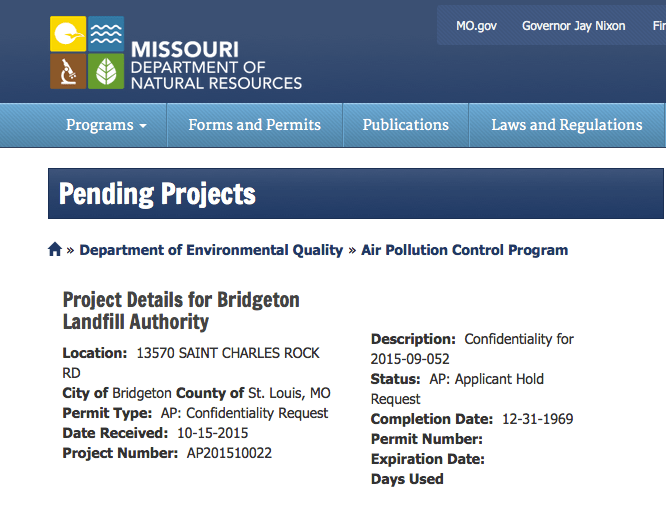
What’s up at the West Lake Superfund site? It’s anybody’s guess. The official operational status of the smoldering landfill at the site has been in limbo for months.  The extent of the ambiguity and accompanying confusion is reflected at the Missouri Department of Natural Resources website, which indicates the Bridgeton Landfill project at the site was completed mere months after the first men landed on the moon.

The unfortunate reality is that cleaning up Manhattan Project radioactive waste at West Lake and other sites in the St. Louis area remains incomplete 46 years after NASA’s successful Apollo 11 lunar landing.


bridgeton-landfill-permit-pending.jpg

A War of Words

Environmentalist Kay Drey continues to advocate for the removal of waste from the radioactively-contaminated West Lake Landfill

first published at stlreporter.wordpress.com, Jan. 23, 2015

“It just makes me sick,” say Kay Drey. The 81-year-old dean of the St. Louis environmental movement is sitting at her dining room table, which is scattered with various paperwork, including two dogeared reports issued by the Nuclear Regulatory Agency in the 1980s.

As the sun streams through a window of her University City home on this mild January morning, she bemoans the state of affairs related to the stalled clean up of the radioactively-contaminated West Lake Landfill in Bridgeton, a nearby St. Louis County suburban municipality.

The NRC reports to which she refers both candidly recommend the removal of the radioactively-contaminated materials from the landfill, which is located in the Missouri River flood plain upstream from water intakes for the city of St. Louis.

The waste, a byproduct of decades of uranium processing carried out by Mallinckrodt Chemical Works on behalf of the government’s nuclear weapons program, was illegally dumped at West Lake 40 years ago. Drey has been fighting various regulatory agencies to get it removed for almost as long.

On this day, Drey’s voice is failing. It can’t compete with Moxie, the family’s small dog, who yaps at a visitor’s feet. After the canine commotion subsides and breakfast dishes are cleared, Drey explains what is bothering her.

“They’re not talking about digging it up,” she says.

Removing the radioactively-contaminated materials from the St. Louis area to a federally-licensed nuclear waste depository in the sparsely-populated West has long been her goal.

In 2008, Drey and the Missouri Coalition for the Environment challenged the EPA’s record of decision on West Lake, which would have mandated a relatively cheap fix — capping the landfill with dirt and leaving the nuclear materials in place. Republic Services, the liable landfill owner, favors this remedy, which would allow the contamination to continue migrating into the ground water. The final decision is still up in the air along with noxious landfill fumes that have been the bane of nearby residents for the last four years.

Since 2010, public outrage over the issue has grown due to an underground fire at the adjacent Bridgeton landfill, which is part of the same EPA Superfund site. The Missouri Department of Natural Resources is overseeing efforts to contain the fire, which is moving in the direction of the radioactive waste. To bolster DNR’s authority, the Missouri Attorney General’s office has filed suit against Republic for various infractions. Splitting responsibility for dealing with the problem between the state and federal agencies has led to further bureaucratic snafus. One of the impasses involves a state-mandated barrier wall to stop the fire from advancing.

Screen Shot 2015-01-23 at 12.55.15 PM

Drey and other activists advocate turning the clean up over to the U.S. Army Corps of Engineers, the agency that has remediated other St. Louis radioactive sites under the Formerly Utilized Site Remedial Action Program (FUSRAP), which targets sites contaminated with nuclear weapons waste from World War II. Gaining congressional approval for such a change has not happened, however, despite efforts by the activists to spur the St. Louis congressional delegation to sponsor the requisite federal legislation.

Meanwhile, Republic, the responsible party, keeps pushing the original capping proposal. The company’s public relations efforts have included backing a rural-based front group, the Coalition to Keep Us Safe which is against shipping radioactive material through the state. The Coalition to Keep Us Safe, via their twitter feed, routinely uses the words “capping” and “encapsulation” to mean the same thing. The terms are used interchangeably by the group, but “encapsulation” is not part of the 2008 Record of Decision issued by the EPA. The confusion of terms is not clear to a casual observer or to many members of the Coalition as seen in the tweets they post.

As the debate wears on, Drey sees support for removal of the waste waning. But she’s standing her ground. There is no compromise on this subject when viewed from her eyes. Those who consider capping as an option are abandoning the goal. In her opinion, it is indefensible to leave deadly radioactive waste to drain inevitably into the Missouri and Mississippi Rivers forever.

Drey also sees how language is being used to obfuscate the issue. Supporters of capping the landfill often use the word “encapsulation” to describe the plan to leave the waste in the floodplain, leaking into the aquifer.

To make her point, Drey gets up from the dining room table and retrieves a worn dictionary from a bookshelf. She runs her index finger down the page to the entry and recites the definition: “Encapsulate: to encase in or as if in a capsule.”

“Does a capsule have just a top?” she asks.

Robert Criss on West Lake

Washington University scientist Robert Criss characterizes the nature of the radioactive waste at West Lake Landfill.

The First Secret City debuts Nov. 15 at noon at the Tivoli Theater as a part of the St. Louis International Film Festival.

Devil on the Rock Road

Tax records suggest access by a giant trash-hauler to landlocked property inside an EPA Superfund site in Bridgeton may be due to special dispensation granted by the Catholic Church. But nobody is confessing to such a Faustian pact.

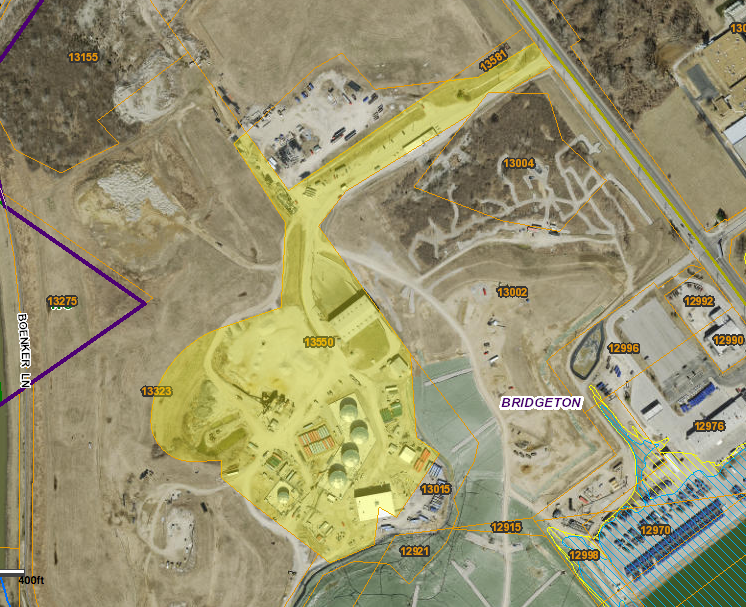
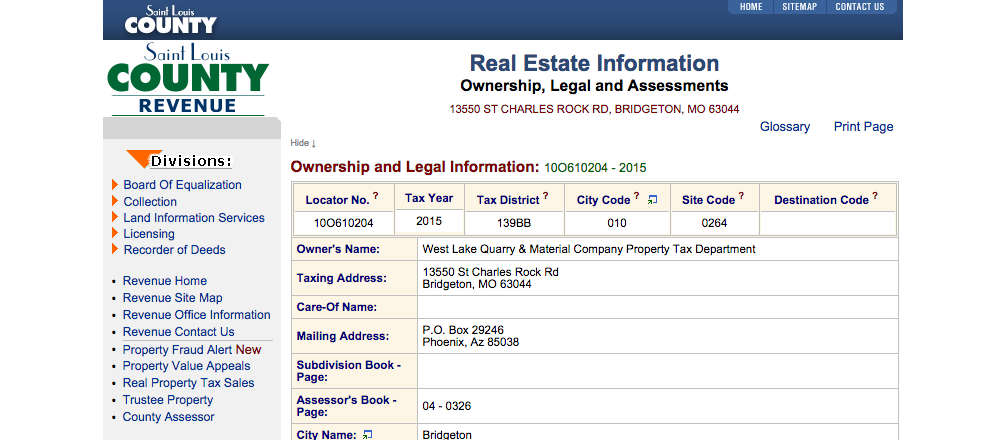
St. Louis County property tax records indicate that the more than 20 acres shaded in yellow inside the EPA Superfund site are owned by West Lake Quarry & Material Co., which is owned by the Catholic Church.

St. Louis County property tax records indicate that the more than 20 acres shaded in yellow inside the West Lake EPA Superfund site are owned by West Lake Quarry & Material Co., which is owned by the Catholic Church.

The EPA website dedicated to the radioactively-contaminated West Lake landfill in Bridgeton offers a vague description of the Superfund site, describing its size as “approximately 200 acres.”

In that sense, the boundaries of the site are as uncertain as the exact location of the nuclear waste itself. On one hand, the uncertainty is due to the failure of the federal regulatory agency to pinpoint the hot spots. That failure comes despite 40 years of oversight.

But there is equal ambiguity related to the history of the impacted properties themselves and their current ownership status. It’s a mystery that the EPA and others, including the St. Louis Archdiocese, don’t seem to want to talk about.

As usual, the devil is in the details, and in this case the details involve the Catholic Church.

St. Louis County land records indicate that the main road leading into the site, as well as more than 20 acres in its interior are still owned by the West Lake Quarry & Material Co. The church took over the quarry operations after the business was bequeathed to it decades ago. Quarry operations ceased years ago, but the corporation itself remains active and charities tied to the church own the company.

St. Louis County real estate records indicate that the West Lake Quarry & Material Co. is the owner of land inside the EPA West Lake Superfund site in Bridgeton. The quarry company is owned by the St. Louis Archdiocese, but the tax bill is sent to a post office box in Phoenix.

St. Louis County real estate records indicate that the West Lake Quarry & Material Co. is the owner of land inside the EPA West Lake Superfund site in Bridgeton. The quarry company is owned by the St. Louis Archdiocese, but the tax bill is sent to a post office box in Phoenix.

In short, the church in this case holds the keys not to heaven but a radioactive waste dump, according to the county  records. But this is where it gets murkier.

Tax records reveal that the tax bill is not sent to the archdiocese or any other identifiable church entity.  Instead, the tax bill is sent to an anonymous post office box in Phoenix, Ariz., the headquarters city of site owner Republic Services, a responsible party for the EPA cleanup.  Since acquiring the property more than a decade ago, Republic has closed other operations, but continues to use the site as a transfer station.

A corporate registration report filed earlier this year with the Missouri Secretary of State’s office shows the president of West Lake Quarry as William Whitaker, a retired mining engineer who lives in O’Fallon, Mo. St. Louis attorney Bernard C. Huger is listed as the secretary of the corporation. The same two individuals are now the sole members of the board of directors. Both men say they represent the church’s interests in the company.

Missouri Secretary of State records from this year show the officers and board members of the West Lake Quarry and Material Co. are longtime representatives of the Catholic Church.

Missouri Secretary of State records from this year show the officers and board members of the West Lake Quarry & Material Co. are longtime representatives of the Catholic Church.

After the church was bequeathed the company, it needed a qualified person to run the business. “They found me 1,200 feet underground,” says Whitaker, who previously supervised a lead mine near Viburnum, Mo. When he took over, the West Lake Quarry was one of a number of holdings owned by the company.

“All of a sudden they (the church) owned a bunch of quarries and they had nobody to run the operation because the owner who was running it had passed away,” recalls Whitaker. “They asked me if I would come up and run the operation. I’ve been in the mining business since 1960, how many years is that?”

When informed that the company was still on the St. Louis County property tax rolls, Huger expressed surprise and attributed it to governmental error.  “I think we sold all that and they don’t have the records right. I don’t know. But that’s a long time ago. I think it’s all long since been sold.”

But a clerk for the St. Louis County Recorder of Deeds office told StlReporter that  property tax recipients were based on information contained in the property deed, and the quarry company’s name appears on the tax bill.

“The quarry is not operating but we keep it open just in case anything would come up from time to time,” Huger says. “There might be some workmen’s comp case come up. Someone might make a claim that (was) an employee. We had one of those a couple years ago. We just keep it open. But it’s really not active. It’s not doing any active business. Let’s put it that way.”

The current shareholders “are several Catholic institutions,” says Huger. He estimates that the business has been dormant 20 years. “I don’t know the exact date. But it’s been a very long time,” he says. At the time the previous owners willed the business to the church, it was a thriving concern. “West Lake Quarry and Material Co. was a big quarry operator with quarries up and down the Missouri and Mississippi Rivers,” says Huger. “The company had towboats and barges.” Incorporation records show that the company’s barge fleeting operations extended southward to states bordering the Mississippi from St. Louis to New Orleans.

Spokespersons for the St. Louis Archdiocese, the EPA and Republic Services refused to comment.

Why Republic Services, a responsible party  for the cleanup, is allowed to conduct a profit-making business inside the site remains a matter of debate. While church and state remain mum on the issue, the question elicited a series of responses at a recent monthly meeting of the West Lake Community Advisory Group (CAG), which acts as a liaison with the EPA.

“I don’t know if the actual road that goes to the transfer station is (part of) the Superfund,” says Ed Smith of the Missouri Coalition for the Environment. “That’s not something I’ve thought about before. So it’s possible that the road is not a Superfund (site).”

Matt LaVanchy, an assistant chief of the Pattonville Fire Protection District, expressed little doubt where the lines are drawn. “It’s my understanding that the areas that are impacted by the radiological material are under the oversight of the EPA,” says LaVanchy.

One thing is for sure: While the public remains confused over the issue,  Republic trash trucks continue to roll in and out of the site as if they have God on their side.