Secret Agent Man

Former EPA official John C. Beale alleged he was a CIA agent for years, attributing his absences to covert missions, and charging the environmental agency nearly $900,000 in travel costs, bonuses and overtime pay. After confessing, he went to prison. His boss — Gina McCarthy — received a promotion.  

screen-shot-2016-10-04-at-14-43-35

When self-professed CIA agent John C. Beale left the halfway house in Philadelphia on June 1, his unheralded release marked the end of a bizarre saga that began quietly in 2000. For the next 13 years, under both Republican and Democratic administrations, Beale told his EPA colleagues that he worked for the CIA.  Finally, when confronted about his alleged covert activities in 2013, Beale claimed he had fabricated his espionage career to get out of work. By this point he had reportedly fleeced the government out of $866,168 in travel expenses, bonuses and compensation. He pleaded guilty of felony theft charges, promptly paid a seven-figure fine and was sentenced to 32-months in federal prison.

Beale served only 18 months before he walked, a veritable slap on the wrist for the crime to which he confessed.  But his boss, EPA administrator Gina McCarthy,  to whom Beale reported, survived the scandal unscathed and was actually promoted to head the agency in the wake of the controversy.

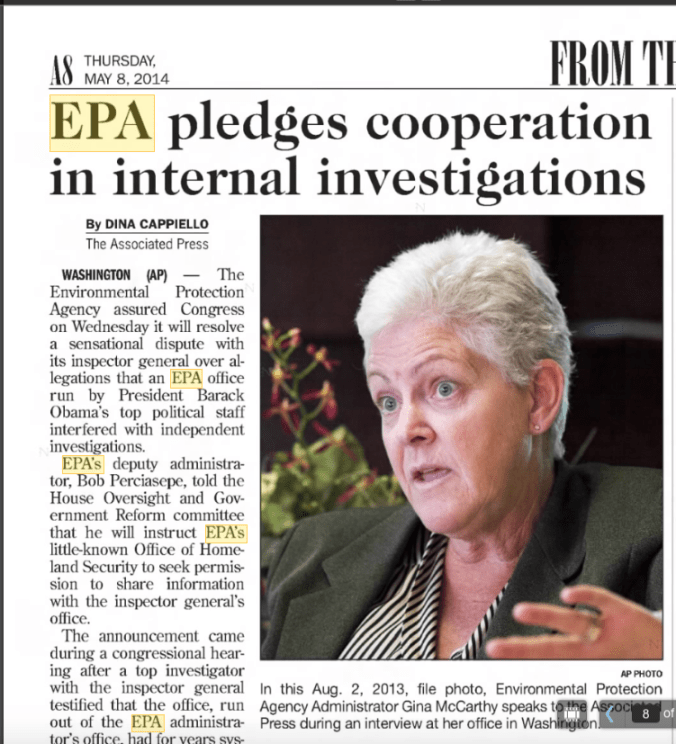
The press had a field day with the Beale affair. C-Span covered the resulting congressional hearings. NBC and the Washington Post reported the story,  as did various online publications and the Associated Press. Wire service coverage appeared in nearly 100 newspapers coast-to-coast. Newspapers that reported the story included the Albuquerque Journal, Pittsburgh Post-Gazette, Iowa City Press-Citizen, Great Falls Tribune, Baxter Bulletin and the Poughkeepsie Journal.

In St. Louis, however, the whole sordid affair went unreported because the The St. Louis-Post-Dispatch failed to mention Beale’s misdeeds.

A significant story involving corruption at the highest levels of a federal agency  were overlooked. An entire metropolitan region  left uninformed by its only major daily newspaper, hundreds of thousands of readers kept in the dark.

For St. Louisans, it was as if the Beale affair never happened.

The lack of coverage by the Post-Dispatch was even more egregious because of the EPA’s mishandling of the West Lake Landfill clean up in St. Louis County.

screen-shot-2016-10-05-at-09-13-41

Radioactive waste from the Manhattan Project and Cold War era had been illegally dumped at the West Lake Landfill in 1973. The EPA had taken over the Superfund site in 1990. But by 2013, the agency had yet to clean up the mess, and the natives were getting restless. Thanks to social media,  a community group dedicated to the issue, STL Just Moms, grew by leaps and bounds. Among its primary goals:  the protection of human health and the removal of the waste from the Missouri River floodplain. Another of the organization’s main objectives is to ditch the EPA altogether and hand over the clean up to the U.S. Army Corps of Engineers.

While the local outrage ramped up here, corruption charges were being leveled against top EPA officials implicated in the  Beale affair.  But in St. Louis few people knew about the agency’s troubles in Washington because of the local news blackout.

screen-shot-2016-10-05-at-09-26-15

In the nation’s capital, it was a big story. The U.S. Senate and House of Representatives took a keen interest in the Beale’s shenanigans and lambasted EPA administrator McCarthy for her involvement.  On October 1, 2013,  for example, Beale himself  was grilled  before the House Committee on Oversight and Reform for hours. His written statement is 263-pages long.

Nevertheless, a blanket of censorship remained in place in St. Louis.

“The name is Beale, John Beale.”

Beale had started working at the EPA in 1988 and was soon elevated to the position of policy analyst. His areas of expertise included the Clean Air Act and climate change. In 2000, he began taking days off of work to allegedly attend CIA meetings. Over the course of the next decade his absences increased. By 2008, his days off increased dramatically, when he requested and received a six month hiatus to ostensibly take part in a CIA covert operation. After the Obama administration came into power in 2009, McCarthy became Beale’s boss in the EPA’s Office of Air and Radiation, and his role as the EPA’s secret agent continued uninterrupted. She didn’t question his alleged CIA ties. If anything, she accepted the idea without reservation.

In September 2011, Beale and two other EPA officials threw a retirement party for themselves on a yacht in the Potomac River. EPA Administrator Gina McCarthy attended the shindig. She considered Beale to be one of her most competent managers. At the same time, she  was also aware of his alleged dual role as a CIA agent, but, nevertheless, lamented Beale’s  departure from the EPA. None of this raised any red flags for a long, long time.

But the saga gets weirder. Beale officially retired in early 2012 but he inexplicably continued to receive his full salary after his retirement. By this time, Beale’s paycheck, which included bogus bonuses, exceeded McCarthy’s  salary. He was the highest paid employee at the EPA and he wasn’t even showing up for work. Beale was pulling down a full-time salary of $206,000 from the EPA — after he had retired.

under the guise of national security

screen-shot-2016-10-05-at-09-17-10

When the EPA Office of Inspector General began investigating Beale, its probe was upended by a little-known subunit within EPA administrator Gina McCarthy’s inner sanctum. McCarthy’s chief of staff was in charge of the obscure detachment, which calls itself the EPA Office of Homeland Security.

This  questionable operation is not part of the Department of Homeland Security and was run without oversight, after being set up in 2003 to deal with possible terrorism threats against sensitive environmental sites. Its intended purpose was to coordinate protocol with the FBI. It has no statutory authority to conduct internal investigations. But that’s exactly what it did in John C. Beale’s case, much to consternation of the EPA Office of Inspector General.

Testifying before the same congressional panel that Beale appeared before, Assistant EPA Inspector General Patrick Sullivan said that the investigation of John Beale had been  obstructed because Beale had been tipped off that he was a subject of interest by McCarthy’s sketchy security apparatus run out her office and headed by Gwendolyn Keyes Fleming, the administrator’s handpicked chief of staff.

“The OHS’ actions, which included several interviews with Mr. Beale, damaged the OIG’s subsequent investigation,” Sullivan told Congress.

McCarthy was far from the only one who believed Beale was a CIA agent. Some of Beale’s colleagues at the EPA still remain convinced that he was a covert operative. Moreover, Beale’s wife was under the assumption that her husband worked clandestinely for the CIA since 1994.

Nancy Kete, Beale’s spouse, met him when she was employed by the EPA. She took a sabbatical from her EPA duties in the early 1990s to work in Paris as an environmental advisor for the Office of Economic Cooperation and Development, an organization that grew out of the Marshall Plan, the United States government’s efforts to rebuild Europe after World War II. By the time the scandal broke in 2012, Kete had made a career change and was the managing director of the Rockefeller Foundation, a position she held until this April.

screen-shot-2016-10-07-at-16-30-54

Kete’s credentials suggest that her professional ties may connect her more to the shadowy world of espionage than her husband’s career path. She reputedly was embarrassed by the exposure that her husband’s escapades received.

Under existing federal law, the CIA must inform other U.S. government agencies if any of its employees also work for the agency. When contacted, the CIA denied any association with Beale.

For his part, Beale expressed contrition for his lies, paid his fine of more than $1.3 million and served his time. In the wake of the scandal, Gina McCarthy was promoted to head the EPA.  The story that wasn’t reported in the St. Louis Post-Dispatch has now been largely forgotten by the rest of America, too.

No progress has been made in cleaning up the  EPA’s West Lake Landfill Superfund site, as a change in presidential administrations nears. The stonewalling and the foot dragging  will likely continue into the next year.

Meanwhile, community activists in St. Louis are continuing to expose the shameful betrayal perpetrated by the U.S. government against its citizens despite lax coverage by the local news media.

Casual readers of spy thrillers are aware that it is standard operating procedure for the CIA to deny involvement when any of its covert actions are publicly exposed. It appears that the EPA operates on the same principle.

John C. Beale may now be long gone, but the game goes on.

screen-shot-2016-10-05-at-08-55-37

Rocky Top

Home values in Spanish Village may have declined due to its proximity to the stinking West Lake Landfill. But besieged subdivision dwellers also live on top of a limestone deposit worth a fortune.

screen-shot-2016-03-14-at-7-01-37-pm

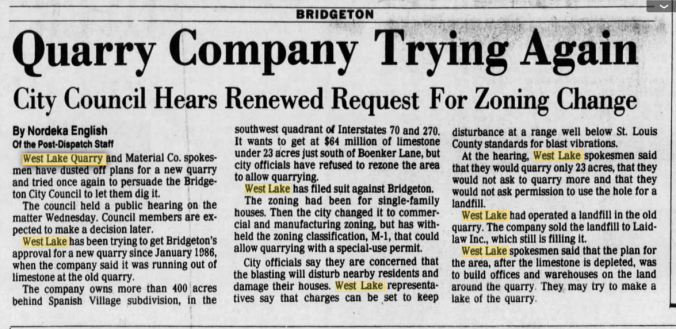
In 1986, the West Lake Quarry and Material Company sought to expand its quarry operations to an adjacent hillside next to Spanish Village subdivision, thereby gaining access to valuable limestone deposits. The city of Bridgeton nixed the proposal.

The ranch-style homes in the Spanish Village subdivision are reminiscent of the not-so-distant past, an idyllic reflection of the 20th Century in our collective rear-view mirror.  Driving by the neatly  trimmed lawns there is no clue that the Bridgeton city park at the end of a cul de sac was once owned by the West Lake Quarry or that it is potentially contaminated with radioactive waste. There’s no hint of the valuable natural resources that lie beneath the surface, either.

Some older residents may remember the park deal that was hashed out in the 1970s by the city council and the then-landfill owners. Records of the sale are buried in the Bridgeton Council minutes. The memory also may lingers the minds of a few present and former locally elected officials.

But they’re not talking.

Talking is something that comes naturally to trial lawyers, however, and, in the summer of 2014, personal injury attorney Daniel P. Finney held court under the eaves of the park pavillion.  A midday thunderstorm rumbled over the hill, but the lawyer didn’t pause. The ensuing rain, offered him a captive audience under the shelter.

As the rain poured down, the lawyer made his best case for signing up with his law firm. He was forthright in his pleadings and offered no promises. He understood the difficulty of proving that radioactive and chemical contaminants from the nearby West Lake landfill had effected the subdivision residents’ health.

Last week, 34 residents, who signed with Finney, reached an out-of-court settlement with a subsidiary of Republic Services, the current owner of the West Lake Landfill Superfund site, where radioactive waste was dumped in 1973. The lawsuit compensates homeowners for their exposure to noxious odors due to an underground fire at the landfill. Terms of the agreement were not made public, but the settlement likely denies the plaintiffs any future redress of grievances.

Those who didn’t take part in the lawsuit remain in limbo. One of the obvious negotiating issues for the Spanish Village property owners is their individual home values, which is based on comparable residential real estate in St. Louis County. The toxic odors wafting from the landfill have decreased home values in the subdivision.

But there is an added value to their property that isn’t being considered. The missing factor in the property evaluation is that the houses are built on top of a precious natural resource — limestone.

The landfill itself, after all, is located at the site of a former quarry, which sits on the edge of the Missouri River flood plain.  Past owners of the landfill founded their business on the presence of the abundant limestone deposits, which are an essential commodity of the construction trade.  In a nutshell, they dug huge holes in the ground to mine and sell the rock deposits and then made more money by charging waste haulers to fill the excavations with all manner of trash, including toxic nuclear and chemical pollutants. The resulting contamination is now leaking into the groundwater.

The EPA has announced it will make its final decision on the clean up plan for West Lake by the end of the year. Under the EPA’s guidelines, there are three proposed alternatives: capping the waste and leaving it in place; excavating and removing it; or a compromise solution that involves a partial excavation. All three alternatives will require massive amounts of  limestone rock materials in one form or another. Transporting the rock from other quarries would be a time consuming and expensive operation.

But there is another option. The nearest limestone deposits to West Lake Landfill are on the adjacent hillside — the location of the Spanish Village subdivision.

The public, including some residents of the subdivision, may not be aware of the limestone deposits, but it is not a secret to state and federal agencies. The U.S. Geological Survey is aware of the limestone deposits because they surveyed the area decades ago. USGS’s counterpart, the Missouri Geological Survey, mapped the area to ascertain the location of mineral deposits in the area. So they know about the location and value of the deposits, too. Moreover, the Missouri Geological Survey is an arm of the Missouri Department of Natural Resources, which is responsible for monitoring the underground fire that is burning at the Superfund site.

There is evidence that that the landfill owners in the past have also been aware of the value of the nearby limestone. That’s because they asked the city of Bridgeton to rezone part of the adjacent hill so it could be quarried more than 30 years ago.

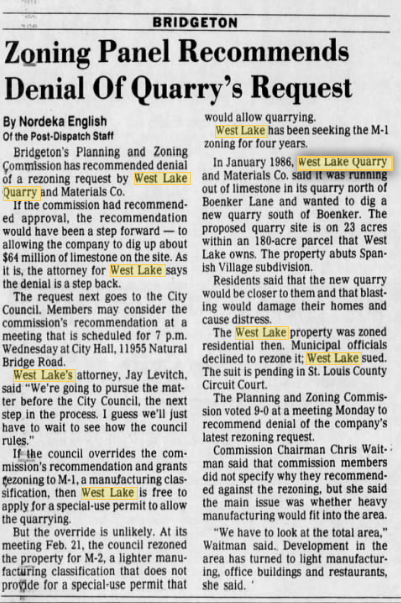
In 1986, West Lake Quarry and Materials Co. asked permission from the city of Bridgeton to expand its quarry operations south of Boenker Lane on 23-acres of a 180-acre tract of land it owned — which abuts Spanish Village. The monetary value of the limestone deposits at the site were estimated in 1986 to be worth $64 million. The Bridgeton Planning and Zoning Commission denied the request.

The  value of the limestone deposits in 2016 would obviously be far greater because of its proximity to the Superfund site. It’s a matter of supply and demand. In short, whoever is contracted to remediate the contaminated landfill by the government is going to need large quantities of limestone rock, gravel and cement.

The radioactive waste at West Lake Landfill was first generated as a part of the Manhattan Engineering District’s secret project to build an atomic bomb. The uranium was processed in St. Louis under a classified contract between the U.S. Army Corps of Engineers and  the Mallinckrodt Chemical Works.

The Manhattan Project was born in secrecy and secrecy remains a constant variable in the 70-year-old saga. There is every reason for this dire situation to be handled with expediency. But history tells us that timely action has never been part of this catastrophe’s chronology.

Openness would offset the doubts and fears that besiege the residents of Bridgeton and the entire region. Instead, negotiations concerning this eminent public health threat are far too often still conducted behind closed doors. Deals are struck, moneyed interests placated.

The trash company liable for this mess bears a name and a logo that evokes patriotism. Its shiny blue trucks lumber through our neighborhoods.  Other responsible parties include Chicago’s electric utility company and the Department of Energy, the successor to the Atomic Energy Commission, which was spawned by the Manhattan Project. This trio’s  combined lobbying power extends from City Hall to the White House.

To believe that they will do the right thing of their own volition is like the proverbial frog  trusting the scorpion to act against its predatory instincts. As the compromises are hashed out and alliances shift, lawyers will continue to talk,  politicians will keep making deals, and the free marketeers will line up once again to feed at the trough.

None of these machinations confront the dangers posed by the nuclear waste that is hitching a ride with fire, wind and rain. Nature is undeterred by human folly. Frankly, it doesn’t give a damn.

screen-shot-2016-03-14-at-6-57-58-pm


Equally obscured by the carefully landscaped yards is the interest that the Missouri Geological Survey had in the area back in the late 1980s, when the agency partially redrew its maps to better understand the composition of natural resources that lie beneath the surface. Understanding the area’s geology of the nearby hills and  adjacent Missouri River flood plain is driven as much by commerce as science.

That’s because the underground karst topography is composed  deposits of limestone, a valuable commodity used for various construction purposes, including levees, roads and home construction.

Residents of Spanish Village nowadays are more concerned about the stench of toxic chemicals whaffing from the nearby West Lake Superfund site, which


ecades ago the Missouri Geological Survey took an interest in the area for reasons other than


New Effort Planned To Get Quarry OK’d

St. Louis Post-Dispatch (MO) (Published as St. Louis Post-Dispatch) – February 26, 1990Browse Issues

The Bridgeton City Council has rezoned about 173 acres near the Spanish Village subdivision so that the land owner, West Lake Cos., can build a factory. But that’s not what West Lake wants.

The company has applied for rezoning that would allow quarrying. The city’s Planning and Zoning Commission is expected to make a recommendation on that matter at a meeting scheduled for 7:30 tonight at Bridgeton City Hall, 11955 Natural Bridge Road.

The company wants to quarry the limestone that lies just under the dirt on the ridge. Company officials say that a 20-year supply, with a value estimated at $64 million, is sitting there. The company has been trying for four years to get at it.

The council rezoned the land at a meeting Wednesday. This was the latest move in a series of rezonings, driven by court rulings since 1986.

West Lake Cos. is owned by the Archdiocese of St. Louis, the Shrine of St. Jude and the Propagation of Faith.

The company owned and operated West Lake Landfill nearby until l988, when Laidlaw Waste Systems bought it. But West Lake Cos. retained ownership of the remainder of the land.

In late 1985, West Lake Cos. determined that it was running out of rock at its quarry north of Boenker Lane and applied to Bridgeton to dig a new quarry south of Boenker. The landfill is operating in the depleted quarry hole.

The land where West Lake wanted the new quarry was zoned for single-family houses. Rezoning was required.

But the landfill and quarry and the potential quarry are situated behind Spanish Village subdivision. Residents there adamantly opposed a new quarry. They said that blasting at the old quarry had shaken their houses and caused them distress.

West Lake officials said that if they didn’t open the new quarry, they would have to lay off most of their workers at the company’s plants nearby.

At one point, the City Council got a petition signed by 125 Spanish Village residents in protest against the proposal for a new quarry and a petition signed by 114 West Lake employees in favor of it.

The City Council declined to change the zoning. West Lake sued. A judge ordered Bridgeton to find a more reasonable zoning than residential for the property. Bridgeton rezoned it to B-5, planned commercial, and M-3, planned manufacturing. Offices could be built in both zoning classifications.

But West Lake pressed the matter in court.

Bridgeton had an M-2 manufacturing classification that would have allowed quarrying with a special-use permit. The city removed the quarrying provision from the M-2 classification. And M-2 is what the council rezoned the area to on Wednesday.

But West Lake has applied to the city for M-1, manufacturing zoning, the only zoning classification that allows quarrying, with a special-use permit. The Planning and Zoning Commission held a hearing on the rezoning at a meeting Feb. 12 and may make a recommendation at tonight’s meeting.

If the council agrees to rezone the area for M-1, then the commission may take up the matter of the special-use permit.

A Disaster Denied

At the turn of this century, the state of Illinois complained that the U.S. Army Corps of Engineers had failed to adequately clean up a radioactively-contaminated site in an African American neighborhood in Madison County. Sixteen years later, the problem remains unresolved.

congo6-1

Driving north on Illinois 3, the hulking World War II vintage factory dominates the surrounding landscape, its  smokestacks towering over vestiges of deteriorating industrial infrastructure linked by rusty railroad tracks.

But the thousands of daily commuters who use this heavily traveled highway between St. Louis and Alton, Ill. can easily whiz by the former Dow Chemical foundry that straddles the towns of Venice and Madison without even noticing it.

For decades, the federal government has been turning a blind eye to the site, too, despite a plea from the state of Illinois to take a closer look at the radioactive waste known to contaminate the area inside and outside of the plant. The contamination is the byproduct of nuclear weapons production from the Manhattan Project and the Cold War.

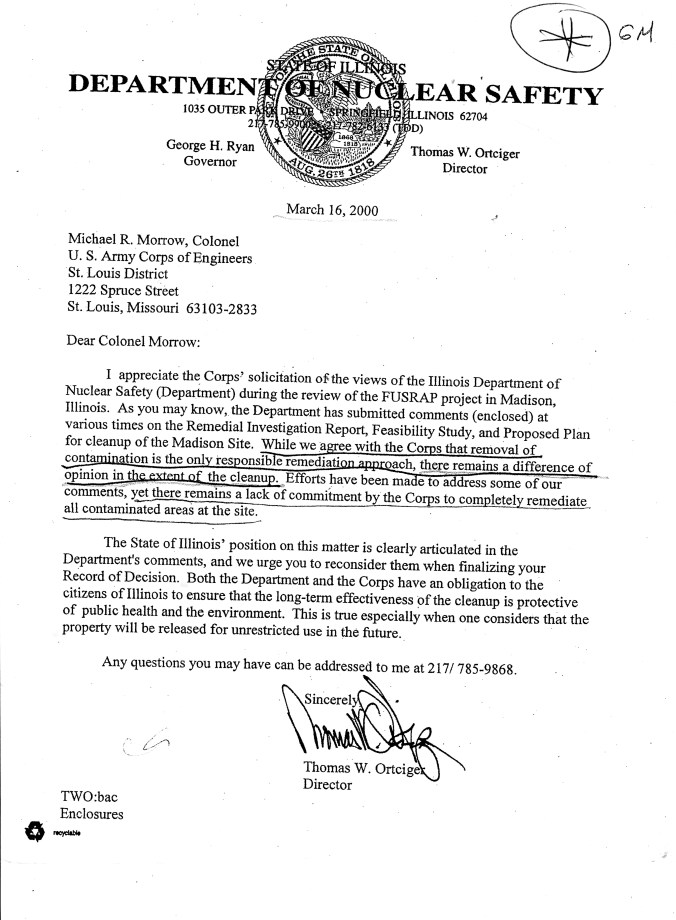
In 2000,  Thomas W. Ortciger, the then-director of the Illinois Department of Nuclear Safety made clear to the U.S. Army Corps of Engineers that the clean up of the site was insufficient to protect the human health of workers or residents. The Corps dismissed his appeals.

“… [T]here remains a lack of commitment by the Corps to remediate all contaminated areas at the site,” said Ortciger. His comment is contained in a letter to the Corps dated March 16, 2000. “The State of Illinois’ position on this matter is clearly articulated in the Department’s comments, and we urge you to reconsider them when finalizing your Record of Decision.”

In comments made at the sole public meeting held prior to Corps decision, which was held on Feb. 25, 2000, the Illinois Department of Nuclear Safety informed that the Corps that its clean up plan was insufficient. “The Corps has inadequately assessed the dose to the first group (workers) and has entirely ignored the second critical group (residents.)

The residents are still being ignored, and many of them have died in the intervening years.

Ortciger_Venice.jpeg

The history of radioactive contamination at the foundry dates back to 1957, when Dow began processing uranium for fuel rods under a subcontract with St. Louis-based Mallinckdrodt Chemical Co., which was working for the U.S. Atomic Energy Commission. The plant was one of hundreds of low-priority radioactive sites nationwide identified by the federal government’s Formerly Utilized Sites Remedial Action Program in the 1990s. The subsequent government-mandated clean-up, which was overseen by the U.S. Army Corps of Engineers in 2000, focused mainly on uranium contamination inside facility and did not include additional monitoring or remediation at the adjacent 40-acre site.

The thorium waste was the byproduct of another facet of the foundry’s operations — production of lightweight alloys used for military and aerospace applications. Between 1960 and 1973 Dow dumped millions of pounds of sludge containing 4 to 8 percent thorium behind the plant on the adjacent property. After Conalco took over the operation, the dumping continued for years, including monthly shipments of thorium waste produced at Dow facilities in Bay City and Midland, Mich.


Hot Wheels

When cyclists spin their wheels this weekend to commemorate the illegal dumping of  radioactive waste at West Lake Landfill, they’ll be riding over a very hot roadbed. 

screen-shot-2016-09-16-at-22-26-12

The Latty Avenue roadbed in Hazelwood, Mo. is constructed of highly radioactive nuclear weapons waste, according  to an overlooked Department of Energy document uncovered this week by the Environmental Archives.

Just hot is it under Latty?

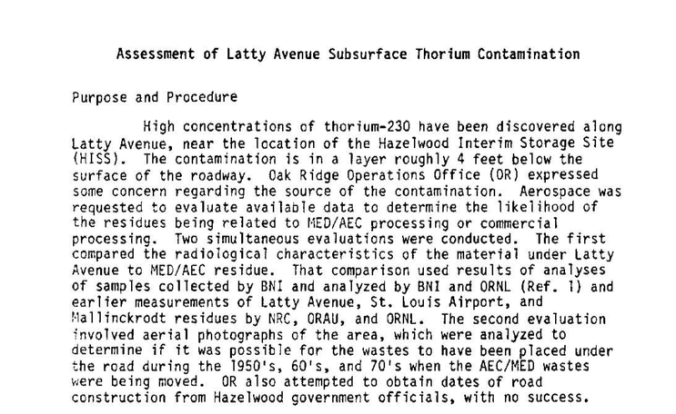
In 1987, Aerospace Corp.,  a DOE contractor, reported the levels of radiation in one hot spot under Latty Avenue were literally off the charts.

“Activities in the “hot spot” sample were so high that quantitative determinations using initial analytical techniques were not possible, and further analyses (sic) will be required,” according to the then-DOE contractor.

screen-shot-2016-09-16-at-22-04-13

The online database released the revelation along with a cache of other records obtained through the Freedom of Information Act.

The release of the document coincidentally corresponds with a planned ride by  bicyclists this Saturday to draw attention to St. Louis’ longstanding radioactive waste problem.

Tons of radioactively-contaminated materials at the Latty Avenue site were transported and illegally dumped at the West Lake Landfill in 1973 over a three-month period.

More than four decades later, the waste is still there, which has led in recent years to a fight by community members to get the EPA to relinguish control of the site to the U.S. Army Corps of Engineers.

The Corps has cleaned up the former storage area on  Latty Avenue and other sites in the St. Louis area as a part of the Formerly Utilized Site Remedial Action Program (FUSRAP).

But the haul route contamination, for the most part, has not been addressed  because it allegedly falls below the current clean-up standards set by the Corps. Radioactive contamination that lies under the pavement is now deemed as safe.

screen-shot-2016-09-16-at-22-29-27

In 1987, it was a different story, however, according to the DOE report made public by the Environmental Archive. At that time, the Aerospace Corp., a DOE contractor, expressed concerns over the high levels of Thorium 230 used to construct the Latty  Avenue roadbed.

The report concludes that the radioactive materials used to build the road in the 1960s or 1970s most likely came from processing waste generated by the Mallinckrodt Chemical Works of St. Louis under contracts with the top secret  Manhattan Project and later the Atomic Energy Commission. Analysis revealed that the high levels of Thorium 230 were evidence that the radioactive contamination was a byproduct of Congolese pitchblende, which is known to be the hottest uranium ore on the planet.

The pitchblende refined by Mallinckrodt was used to build the first atomic bombs.

screen-shot-2016-09-16-at-22-35-33

screen-shot-2016-09-16-at-21-56-45

Deaths in Venice

In 1989, the Consolidated Aluminum Corp. (Conalco) and Dow Chemical Co. began to quietly clean up a 40-acre site adjacent to a foundry in Madison, Ill., that the two companies formerly owned. The plant and dump site are both located on the boundary between the Metro East cities of Madison and Venice.

The clean-up entailed dividing the area into a massive grid made up of hundreds of squares and then using a complicated formula to measure the contamination levels in each of them. To carry out the job, contractors constructed a laboratory, rail spur and loading station.

By the time the project ended in December 1992 more than 105,000 tons of thorium-contaminated slag had been loaded into 978 rail cars and shipped to a low-level radioactive waste facility in Utah, according to a final report prepared for the Illinois Department of Nuclear Safety (IDNS), the state agency responsible for overseeing the clean-up.

The 1992 report states: “Because of the proximity of the contaminated area to a residential neighborhood, and the inconvenience that the construction activity imposed upon the neighborhood, the construction was done in a manner such that all contaminated material above natural background was removed and the area was backfilled immediately. ” …

The history of radioactive contamination at the foundry dates back to 1957, when Dow began processing uranium for fuel rods under a subcontract with St. Louis-based Mallinckdrodt Chemical Co., which was working for the U.S. Atomic Energy Commission. The plant was one of hundreds of low-priority radioactive sites nationwide identified by the federal government’s Formerly Utilized Sites Remedial Action Program in the 1990s. The subsequent government-mandated clean-up, which was overseen by the U.S. Army Corps of Engineers in 2000, focused mainly on uranium contamination inside facility and did not include additional monitoring or remediation at the adjacent 40-acre site.

The thorium waste was the byproduct of another facet of the foundry’s operations — production of lightweight alloys used for military and aerospace applications. Between 1960 and 1973 Dow dumped millions of pounds of sludge containing 4 to 8 percent thorium behind the plant on the adjacent property. After Conalco took over the operation, the dumping continued for years, including monthly shipments of thorium waste produced at Dow facilities in Bay City and Midland, Mich.

The Dow-Madison Site

“For decades radioactive dust was falling on me and my coworkers everyday,” says Larry Burgan, a 50-year-old disabled steelworker. “Millions of pounds of uranium were processed through my machine and no one ever told me — never told us. We deserve justice; justice not just for the employees, but the residents, too.”

The problems at Spectrulite began the year before Burgan was born, when the foundry was owned by Dow Chemical Co. Dow processed uranium at the plant between 1957 and 1961 under a subcontract with St. Louis-based Mallinckrodt Chemical Co., which was working for the U.S. Atomic Energy Commission (AEC). Dow’s work caused radioactive debris to accumulate on overhead girders — where it was ignored for decades.

In 2000, when the U.S. Army Corps of Engineers oversaw a radioactive cleanup at the Spectrulite plant, a spokesman for the agency assured employees and the public that the radiation levels inside the plant were low and there was no reason for concern. But in less than a year Burgan’s health began to decline.

He says the first hint was when he noticed shortness of breath after climbing stairs. Then he developed a pain in his right foot. His hair began to fall out. Over the next year, his condition improved temporarily and then worsened. He started experiencing severe joint pain throughout his body. His doctor’s visits became more frequent and he was having difficulty doing his job. Eventually, he became bedridden and unable to walk. A severe rash covered his entire body. …

The Department of Energy conducted the first radiological testing at the facility in March 1989, which showed elevated levels of Uranium-238 and Thorium-232.  A story published in the St. Louis Post-Dispatch the previous month had spurred the government to do the testing. The story was based on the earlier research of Kay Drey.

In 1979, the St. Louis environmental activist had interviewed a terminally-ill truck driver who had delivered uranium ingots from Mallinckrodt Chemical in North St. Louis to the Dow plant in Madison. The truck driver attributed his lung cancer to his occupational exposure to radiation in the late 1950s and early 1960s.

The Madison plant had assembled tanks during World War II. Six years after the war, the federal government sold the facility to Dow. In 1957, Dow was licensed by the AEC to process fuel rods for nuclear reactors under the subcontract with Mallinckrodt. The uranium processing continued for four years. During that time, radioactive dust escaped as the uranium was heated up and forced through the extrusion press.

But uranium wasn’t the only radioactive material discovered by the Energy Department in 1989. Government records obtained by Burgan also show elevated levels of thorium present in the overhead girders. The records also show that by the summer of 1960, the plant had imported 80 tons of thorium pellets from Canada. Thorium was used in the making of lightweight alloys for military and aerospace applications, another job that Dow did at its Madison plant.

As work continued, the nuclear waste mounted. Dow’s original disposal plan called for the waste to be incinerated. But the burning couldn’t keep up with the increased volume of waste that was being generated. So between 1960 and 1973, Dow dumped millions of pounds of sludge containing 4 to 8 percent thorium behind the plant in a vacant lot that is adjacent to neighborhood residences. This level is several times over the current safety standards. Company guidelines also permitted up to 50 pounds of thorium sludge per month to be poured directly down the sewer. The radioactive contamination could also have been released into the environment by the plant’s several 20-foot diameter exhaust fans.

Borderline Crazy

Mallinckrodt radioactive waste generated in St. Louis ended up at the Lake Ontario Ordinance Works in upstate New York

Between 1944 and 1950, radioactive materials produced as part of the Manhattan Project by Mallinckrodt Chemical Works of St. Louis were secretly shipped to a site near Love Canal in New York state, according to a long-forgotten investigative story by the New York Times.

The contaminated site, ten miles north of Niagara Falls, was the original location of the Lake Ontario Ordinance Works. The Times published the details of the environmental quagmire in June 1980, more than 35 years ago.

In its investigative report, the Times revealed that more than 20,000 tons of radioactively contaminated materials were transferred from uranium refining operations in Townawanda, N.Y. and St. Louis in 1944 (see below excerpt from New York Times story). Mallinckrodt began purifying uranium for the first atomic bombs manufactured in World War II in March 1942, and continued the operations for 20 years during the Cold War.

Much of the uranium was known as Belgian Congo pitchblende, the purest form of the ore. During World War II, the Congo was still a colony of Belgium. Under an agreement with the U.S. Army Corps of Engineers, the Belgian-government-owned African Metals Corp. retained ownership of the valuable minerals found in the residue after processing.

Radioactive waste from Mallinckrodt is also known to have contaminated sites in St. Louis County, Mo.; Canon City, Col.; Fernald, Ohio and elsewhere. Before Mallinckrodt began its uranium refining operations it, it procured a waiver for all liability from the U.S. government.Niagara_2

NiagaraSTL

Coldwater is Hot

When C.D. Stelzer called the Department of Energy’s FUSRAP office back in 1997, a secretary for a private company answered the phone, two corporate managers acted as mouthpieces for the government,  and the DOE official in charge had gone elk hunting.

first published in the Riverfront Times, Dec. 3, 1997

IT’s shift change on Friday afternoon at the Boeing plant north of Lambert Field and workers are fleeing in droves, streaming bumper-to-bumper down McDonnell Boulevard, oblivious to the narrow, 21.7-acre piece of real estate next to the thoroughfare. Until recently, this barren stretch of earth offered little to see besides an abundance of weeds surrounded by a rusty cyclone fence topped with barbed wire. In late September, however, the U.S. Department of Energy (DOE) began rearranging the landscape on the property. From the shoulder of the road, where it crosses Coldwater Creek, a yellow bulldozer and backhoe can now be seen parked near a plywood wall extending across the top of the steep embankment leading down to the creek bed.

It’s hard to tell, at a glance, that the work in progress here is part of an overall federal project estimated to cost nearly $800 million. Ordinary building materials — bales of straw, rocks and plastic sheeting — create a setting common to construction sites. But this is no ordinary erosion-control action. Soil at this location, known in regulatory circles as SLAPS (St. Louis airport site), harbors deadly byproducts of the nuclear-weapons industry, which developed during World War II and mushroomed in the Cold War. From 1946 until the mid-1960s, the U.S. Army — and, later, the Atomic Energy Commission (AEC) — dumped hundreds of thousands of cubic yards of radioactive waste, 100_1341residue from uranium processing at the Mallinckrodt Chemical Works in St. Louis.

As a consequence, the acreage, which is now owned by the St. Louis Airport Authority, has been contaminated with increased levels of uranium-238, radium-226 and thorium-230, according to the DOE. This is no new discovery, of course. Official foot-dragging has been going on for decades. More than 20 years ago the DOE discovered that contaminants had migrated into ditches next to McDonnell Boulevard, where they have settled only inches from the surface. There are still no signs to warn passersby or curious onlookers of this danger.

Failure to inform the public and act in a timely manner has been the hallmark of this case. At the same time, public-health officials have consistently downplayed or ignored the potential health consequences of radiation exposure. After allowing the waste to spread for more than 50 years, the federal government is now belatedly rushing to deal with the problem in a fashion comparable to its past negligence. In the process, rules have been sidestepped and decisions made without a full understanding of their implications. The powers-that-be first attempted to keep the problem a secret, after World War II, for “national-security reasons.” By the late 1970s, however, the festering pollution had become a heated public issue.

The waste itself has proven even more difficult to contain than the controversy over it.

COLDWATER CREEK, which is next to the site, flows through a large section of North St. Louis County and has acted as a convenient vehicle to transport the toxic materials. So far, radioactive contaminants are known to have hitched a ride downstream more than seven miles, according to the DOE. And the migration is continuing. Tests conducted in late 1994 show stormwater runoff at the location still exceeding acceptable radiation levels set by the agency. Drinking-water intakes for the city of St. Louis are located several miles downstream from the site, on the Mississippi River at Chain of Rocks. The radioactive migration by way of groundwater has also been confirmed but is less well understood.

For years, the DOE claimed the waste presented no danger. But the scientific community, which has been moving much more slowly than the waste, has finally concluded that no safe level of radiation exposure exists. By the time this decision was made several years ago, it was also widely accepted that one direct effect of long-term exposure to low-level radiation is cancer.

The $8.3 million cleanup along Coldwater Creek is the first stage of the long-anticipated project. The initial phase involves removing at least 6,000 cubic yards of the contaminated soil to a licensed repository for low-level radioactive waste, located in Utah. The amount is only a small fraction of the contaminated materials that may ultimately be excavated and shipped from the site. The approximate completion date: 2004.

But the entire project now stands in bureaucratic limbo. Less than a month after the DOE started working at the airport site, Congress transferred authority for the cleanup to the U.S. Army Corps of Engineers. The change came about as a part of the latest Energy and Water Appropriations Bill, signed into law by the president in October. Under the legislation, the corps will be handed the remainder of the $5 million already allocated to the DOE for this fiscal year to shore up the small section of Coldwater Creek. The money is in addition to the $140 million appropriation for 1998 that continues funding a nationwide cleanup of low-level radioactive-waste sites. The act also stipulates that the corps must conduct a three-month assessment of the Formerly Utilized Sites Remediation Action Program (FUSRAP), the federal aegis under which the airport site falls.

For the time being, the cleanup of Coldwater Creek is expected to continue uninterrupted, according to David Leake, project manager for the corps. “Congress has made it fairly clear that they do not want the transfer to result in any delay,” says Leake. This pragmatic strategy, however, locks the corps into adopting some of the DOE’s prior policies and practices, many of which have fallen into question in the past.

R. Roger Pryor, executive director of the Missouri Coalition for the Environment, says the corps isn’t carrying the same baggage as the DOE. “I feel the corps doesn’t have the past bias that nuclear waste is somehow good for you,” says Pryor. “However, changing horses in midstream is difficult.”

Even though the airport site is on the U.S. Environmental Protection Agency’s (EPA) National Priorities List (NPL), the DOE, through a regulatory loophole, was allowed to proceed with the Coldwater Creek excavation without formulating any long-range cleanup plan for the entire site. Furthermore, the DOE’s interim plan admits the area now being dug up may have to undergo remediation again sometime in the future. In other words, the current work is at best a stopgap measure. The project may also leave some radioactive contaminants behind because the excavation doesn’t go deep enough. In addition, the DOE started working on the site before a hydrogeological study, which it commissioned, had been completed. A previous hydrogeological study, published last year, cautioned that the groundwater system underneath the site was not clearly understood. The panel of experts concurred that implementation of any excavation work would necessitate further site characterization.

Specifically, the panel, which comprised government and industry scientists, warned of the existence of large volumes of radioactive contamination in the middle of the 21.7-acre site. The location of those contaminants is uphill from the current excavation work. It doesn’t take a nuclear physicist to figure out
that water rolls downhill. By beginning the cleanup at the low end of the site, the DOE hoped to create a buffer that would stop or at least slow the migration of the radioactive pollutants into the creek. But by starting at this point, the department admittedly risks re-contaminating the area it has chosen to clean up. Sheet erosion from rainfall will continue to allow contaminants to move toward the creek. Groundwater will head in the same general direction. Indeed, the subterranean currents may circumvent the DOE’s efforts altogether because, according to the experts, the hydrogeological structure beneath the site pushes groundwater both north and west under McDonnell Boulevard.

“I’m delighted that they are beginning to clean up the airport site,” says Kay Drey, an environmental activist from University City. “But they’re not doing it safely.” Drey, who fought for the cleanup for years, resigned from the project’s oversight committee on Sept. 18 (see accompanying story). In her resignation letter to St. Louis County Executive George “Buzz” Westfall, she expressed disapproval of the DOE’s interim plan, citing what she considers to be inadequate precautions. Before her resignation, she had submitted a detailed eight-page critique of the DOE’s plan. To date, she has received no answers to her questions.

FROM THE MCDONNELL Boulevard bridge, the turbid waters of Coldwater Creek are visible, flowing past chunks of concrete debris and swirling around a white plastic lawn chair marooned midstream. It is a typical suburban scene, a once-pristine waterway relegated to carrying sewage. Coldwater Creek carries other pollutants, too: Jet fuel from nearby Lambert Field has found its way into the watershed, as have salt, oil and automotive antifreeze, according to a DOE assessment. Another pollutant in the surface water is trichloroethylene, a known carcinogen. No one is certain of the long-term effects of such mixed waste on the environment or human health. It is also unknown how the chemical stew affects the migration of radioactive contaminants in surface and groundwater.

In essence, the airport site is a very large experiment with few scientific controls attached.

On the basis of data provided to it by cleanup-site contractors, last year’s hydrogeological panel decided contamination levels at the site would not pose an imminent risk for the next 100 years, an arbitrary figure imposed by the DOE’s guidelines. Yet some radioactive isotopes already discovered in ground and surface water at the site will last for hundreds of thousands of years. Although it downplayed the risks over the next century, the panel nevertheless concluded it would be inappropriate to use the site for long-term storage and repeatedly stated that many questions about the hydrology of the area remain a mystery.

Seepage of radioactivity into groundwater is by no means unique to St. Louis. Last week, the DOE formally admitted that the aquifer underlying the 560-square-mile Hanford nuclear reservation in Washington state has been contaminated. The radioactive waste, which is moving toward the Columbia River, is the result of 40 years of plutonium production at the site. The DOE, which long denied that groundwater contamination existed at Hanford, now claims the Columbia will not be threatened for the proverbial 100 years. However, the independent scientific analysis that forced the DOE to confess to the groundwater contamination calls the DOE’s estimates on risks to the river “unreliable.”

Tom Aley, a hydrologist who sat on the panel that studied the St. Louis airport site, is sure of one thing: The waste should have never been dumped here in the first place. Similar to Hanford, the waste here is situated on top of an aquifer. “It is a very poor site for disposal of that type,” says Aley, who owns Ozark Underground Laboratory Inc. Aley lists population density, groundwater contamination and the proximity of the site to Coldwater Creek as reasons not to store radioactive waste at the airport site.

His tempered approval of the cleanup is based in part on the lack of groundwater use in the area. However, Aley concedes there is much yet to be learned. “We don’t really have a good understanding of the vertical contamination,” he says. “The waste was deposited in a very haphazard manner, which was typical of that era. That has made cleanup very difficult. Another thing is, you can never totally clean up a site. A lot of these cleanups are real bootstrap operations. You have to pull one boot up, and then you have to pull the other up.”

The emperor may have buckled his boots, but he is without clothes. In short, no plan exists as to how to proceed with the remainder of the cleanup. Indeed, according to details of the DOE’s interim action, the current $8.3 million creek cleanup may ultimately have to be redone. The DOE’s engineering evaluation/cost analysis clearly states: “Although final clean-up criteria have not been established for this site, it is anticipated that the majority of the area cleaned up by this action will not require additional effort. However, final clean-up criteria, once selected, could require additional efforts in areas excavated in this removal action.”

Although the DOE acknowledges contamination at the site extends at least 18 feet deep, its interim plan requires digging only “eight to 10 feet below the existing land surface,” according to a Federal Register notice published in September. The DOE also acknowledges that “soil contaminated with radionuclides is present below (the) water table.” If contaminated groundwater is encountered during the dig, the DOE’s interim plan calls for it to be pumped onto high ground, which means it will re-enter the aquifer or run back downhill, toward the creek.

To battle this inevitable gravitational pull, the DOE has built a berm to separate the excavation work from the rest of the site. The interim action also calls for a channel to be constructed to reroute stormwater away from the roadside ditch that drains into the creek. In 1985, the DOE constructed a gabion wall — rocks secured by a wire basket — to hold the bank from sliding into the creek. It is a porous structure that by design allows water to percolate through. Whereas the effectiveness of these measures is subject to debate, there is no argument that radioactive sediments can still move downward into the aquifer and flow northwest under McDonnell Boulevard, thereby entering the creek unimpeded.

The hydrogeological study from last year warned about this possibility. “Groundwater monitoring has shown the migration of radionuclides in the direction of groundwater flow across McDonnell Boulevard and under the formerly used ball fields property to the north,” according to the study. “This factor raises concern over potential shallow discharge of radionuclides to Coldwater Creek to the west and north and potential vertical migration to the lower aquifer system.”

Three thousand people live within a one-mile radius of the airport site, according to DOE estimates. From the airport, Coldwater Creek flows northeast for 15 miles, touching the communities of Berkeley, Hazelwood, Florissant and Black Jack before discharging into the Missouri River. The city of St. Louis drinking-water intakes at Chain of Rocks, which supply water to hundreds of thousands of people, are five miles downstream from where the Missouri joins the Mississippi.

By any standard it is a densely populated watershed. DOE guidelines for thorium and radium concentrations mandate they not exceed 5 picocuries per gram averaged over the first 15 centimeters of soil and 15 picocuries per gram in subsequent soil layers of the same thickness. Analysis conducted for DOE in 1985 indicates that soil next to Coldwater Creek is contaminated with as much as 14,000 picocuries of thorium-230 per gram. The naturally occurring background level for the same radioactive isotope amounts to 0.2 picocuries per gram.

The corresponding guideline for acceptable DOE levels of uranium-238, which is also found at the airport site, is 50 picocuries per gram. In 1981, DOE initiated a two-year groundwater-monitoring program at the site and discovered uranium-238 at concentrations up to 2,230 picocuries per gram. Other evidence shows radioactive waste is spread across the site at levels thousands of times greater than considered acceptable.

A curie is the amount of radiation emitted from one gram of radium, equal to 37 billion decays per second. A picocurie equals a trillionth of a curie. Curies are used to measure the amount of material present; they don’t indicate the amount of radiation given off or its biological hazards.

Such DOE standards ignore potential health consequences, according to a 1991 congressional study. “The present regulatory-driven approach … places far more emphasis on characterizing the contamination than on investigating health impacts and may prove ill-suited to identifying public health concerns, evaluating contamination scenarios according to their potential for adverse health effects, or establishing health-based clean-up priorities,” the Office of Technology Assessment report states.

JOHN W. GOFMAN, a professor emeritus of medical physics at the University of California at Berkeley, has long contended that there is no safe level of radiation exposure. “I concluded it’s impossible for such a level to exist given the evidence on how radiation works,” says Gofman. The term “low-level radiation” is a political term used by the nuclear industry to lull the public into accepting exposure risks, he says. Similar phrases also downplay the consequences. “The terms `tolerance level,’ `allowable level,’ `permissible dose’ — those are all phenomenal words that are supposed to tell Joe Six-Pack, `Nothing to worry about — there ain’t no harm.’ That’s why these terms came into existence,” he asserts.

The 79-year-old Gofman is in a unique position to advise on such matters because he is a physician and holds a doctorate in nuclear physical chemistry. His research at Berkeley during World War II attracted the attention of J. Robert Oppenheimer, lead scientist in the Manhattan Project. After working on the atomic bomb at Oppenheimer’s request, Gofman completed his medical studies. But in 1969, Gofman fell from grace with the atomic establishment when he challenged the “acceptable” levels of radiation exposure then allowed.

After being ostracized by the atomic establishment for years, Gofman’s scientific opinions have been widely accepted of late. In 1990, for instance, after years of debate by U.S. scientists, a report by the fifth conference on the Biological Effects of Ionizing Radiation (BEIR V) concluded that radiation effects are proportional to dose in all cases. More recently, says Gofman, “The United Nations Scientific Committee on the Effects of Atomic Radiation said that the weight of evidence comes down on the side of no safe level. And the British National Radiological Protection Board in 1995 published a document in which they have now said that there can be no safe dose.”

Studies such as these lead Drey, the environmentalist, to question the logic of allowing further radioactive contamination to flow into Coldwater Creek. “Dilution is not the solution to pollution in reality or legally,” says Drey. “When you are dealing with materials that will continue to give off radioactive particles forever into the future, literally billions of years, you have to be very careful with this stuff.”

THIS IS NOT THE FIRST TIME Drey has opposed a DOE project. In 1993, she battled the department’s plans to clean up radioactive waste at nearby Weldon Spring in St. Charles County (“Rushing Water,” RFT,Jan. 6, 1993). Her vigilance then temporarily delayed that project, after she exposed the fact that the DOE was going ahead before receiving critical EPA test results.

Stephen H. McCracken, who headed the Weldon Spring cleanup, took over as St. Louis airport-site manager for the DOE earlier this year. Although the circumstances and nature of the radioactive waste may be different at the airport site, McCracken’s job switch hasn’t seemed to have affected his ability to circumvent government guidelines. If anything, the DOE official’s evasive end-runs appear to have improved over time.

Pryor, of the Coalition for the Environment, recalls that the decision was railroaded past the citizens oversight committee on which he sits. “We had hardly seen this darn thing,” says Pryor of the recommendation to proceed with work along the creek. “When we asked McCracken in September, he admitted it was just a guess,” says Pryor, referring to the point at which the DOE decided to begin excavating. The measure squeaked past the committee on a 4-3 vote. “We thought it was silly to go forward without the geological study,” says Pryor.

On Sept. 18, the day Drey resigned, McCracken signed a memorandum, which was immediately filed away. The memo cites an emergency clause that allowed him to waive the DOE’s standard 15-day public-review period for such actions. Sept. 18 also just happened to be the day DOE issued its “Flood-plain Statement of Findings” in the Federal Register. The purpose of the posting was to notify individuals and other government agencies of the pending action at the airport site so they could scrutinize the plan in advance. The notice clearly states: “DOE will endeavor to allow 15 days of public review after publication of the statement of findings before implementation of the proposed action.”

Four days later, on Sept. 22, work began at the St. Louis airport site.

Every conceivable government agency — local, state and federal — was left out of the loop. Even the DOE official who has oversight into such matters said he was unaware the emergency clause had been invoked. “I suppose you’d have to ask Steve McCracken about that,” drawled James L. Elmore, a National Environmental Policy Act (NEPA) compliance officer for the DOE in Oak Ridge, Tenn. “I don’t have anything to do with that. You’d really have to ask him exactly what his total thought process was.” Despite his ignorance, Elmore’s name appears on the bottom line of the Sept. 18 Federal Register notice.

The RFT could not initially reach McCracken to explore his “thought process,” because, according to the secretary at the DOE site office, he was elk hunting in Colorado. After returning from his expedition, the DOE manager still did not return repeated calls placed to his office for a week. In his Sept. 18 waiver memo, however, McCracken wrote he had expedited the cleanup out of concern that autumn rainfall would make excavating near the creek more difficult. Come hell or high water, McCracken is expected to continue working at the site, at least during the transition period.

The airport site is on the Superfund’s NPL list, according to Dan Wall at the EPA regional headquarters in Kansas City. Because of its priority status, the agency is obliged to oversee the cleanup, he says. But it appears the contractors are more in control of the project than anybody else.

Calls placed to the DOE’s site office in St. Louis are answered by the cheerful voice of Edna, a secretary who works for Bechtel National Inc., one of the DOE’s prime cleanup contractors. She takes messages for McCracken and his assistant. In this case, she took messages for nearly two weeks, and for nearly two weeks the calls went unreturned. Finally, representatives for the DOE’s two prime contractors called back.

A secretary for a private company answers the phone at a government office, two corporate managers act as the mouthpieces for a government project, and the government official who is supposed to be in charge is elk hunting. This gives the appearance that the tail is wagging the dog. That may soon change under the new leadership of the corps. “The corps and the DOE operate somewhat differently,” says Leake. “The DOE will put very few people on a particular program and rely heavily on large national contractors to do a lot of the things that the Corps of Engineers try to do internally.”

The change in management styles will affect all of FUSRAP, which originated in 1974 under the AEC, the predecessor of the DOE. AEC established FUSRAP to deal with radioactive waste produced as a byproduct of nuclear-weapons production. Of the 46 FUSRAP sites across the country, 25 have been cleaned up, according to the DOE. Four remaining radioactive hotbeds are in the St. Louis area, with the airport site the largest.

In St. Louis and elsewhere, the DOE has relied on the expertise of Bechtel and Science Applications International Corp. to carry out its mission.

Wayne Johnson, the deputy project manager for Bechtel in St. Louis, is certain the cleanup next to Coldwater Creek is being carried out safely. “These measures have been monitored by the Missouri Department of Natural Resources, which has had representatives on the site routinely to look at our operations to make sure that we are not affecting the creek. In addition to that, St. Louis County, which has advised us on our plans for the work, has been out to the site,” says Johnson. “So we feel confident, and we are more than halfway done. We have not had any problems or affected the creek in any way.”

Ric Cavanagh of the St. Louis County Health Department, who chairs the citizens oversight commission, agrees with Johnson’s assessment. “I’m not a lawyer, but it is my understanding that they (the DOE) did make use of a provision in the rules to move forward. The majority of the oversight committee voted in favor of proceeding with the work,” says Cavanaugh. “We are purely advisory. We couldn’t have stopped it if we wanted to. The groundwater levels were very low at the time, and this was a very good time to get things going. (St. Louis County’s) goal was to get excavation begun and to get work begun at that site. So we were pleased to have it go from that standpoint.”

The oversight committee currently has 11 members — five from the city of St. Louis and six from St. Louis County. One seat remains vacant at this time. The board replaces an advisory task force that disbanded last year.

AT ONE TIME, workers toiled night and day to dump the radioactive waste at the airport site. The open pile rose to 20 feet above ground level, according to one DOE document. Altogether the accumulated waste at the site and elsewhere nearby is estimated to have once ranged from 283,700 to 474,000 cubic yards, according to the DOE. In additional to open dumping, Mallinckrodt workers were required to hand-pack waste in 30- or 55-gallon drums. The drums were then stacked on top of each other at the airport site. The barrels then began to leak.

In the process of storing the waste, haul routes and adjacent properties became contaminated. Then in 1966, the AEC sold most of the residues to Continental Mining and Milling Co, which promptly transported the waste to 9200 Latty Ave. in Hazelwood and then went bankrupt. The movement resulted in the contamination of more properties. Cotter Corp., a subsidiary of Commonwealth Edison, subsequently acquired the materials, with an eye toward reclaiming some of the minerals. The bulk of it ended up in Canon City, Colo., but not before one of Cotter’s subcontractors dumped thousands of tons of the waste in the West Lake landfill off Old St. Charles Rock Road in North St. Louis County.

More than 50 years after it started, the uranium-processing operation conducted at Mallinckrodt in St. Louis has forced almost $800 million in reparations on U.S. taxpayers — the cost of cleaning up the radioactive vestiges of World War II and the arms race that followed. To the victors go the spoils. It is a small part of the environmental damage wrought by the federal government and the nuclear-weapons industry over the last half-century — damage estimated to cost $200 billion to correct. What can never be measured are the lives cut short because of radiation exposure. Men have been tried for war crimes that did far less.

Final Judgment

hulen.jpg.

Rubey M.  Hulen, the judge who signed off on the airport nuke-waste dump, later sentenced himself to death.

On the morning of July 7, 1956, federal district Judge Rubey M. Hulen, had breakfast with his wife before a scheduled doctor’s appointment at Barnes Hospital in St. Louis.

He never made it to the appointment.

An excerpt of the 1946 Land deed for the St. Louis Airport Site that includes Judge Rubey Hulen's signature.

An excerpt of the 1946 Land deed for the St. Louis Airport Site that includes Judge Rubey Hulen’s signature.

Instead, he was pronounced dead at the same hospital later that day. The family gardener found Hulen’s body at approximately 10 a.m. lying in the backyard at 16 Southmoor Drive in Clayton. The death certificate indicates Hulen died of a gunshot wound to the right temple. A .32-caliber revolver was found next to his right hand.

Nearly a decade earlier, on September 23, 1946, Hulen signed an order sanctioning the taking of 21-plus acres adjacent to the St. Louis airport. The acquisition by the U.S. War Department was carried out quietly on behalf of the top-secret Manhattan Engineering District, which purchased the land for $20,000 to store radioactive materials produced by Mallinckrodt Chemical Works of St. Louis. The materials were byproducts of uranium processing used to create the first atomic bombs and subsequent nuclear weapons work.

For the next twelve years, open dump trucks loaded with radioactive residues continued to be shipped from Mallinckrodt’s plant on North Broadway to the airport location. As the piles grew, radioactive contamination migrated off site, draining into nearby Coldwater Creek, which flows through the sprawling suburban communities of North St. Louis County.

The U.S. Army Corps of Engineers began cleaning up the creek in the late 1990s and the work continues today.

At the time of his death,  Judge Hulen, a Roosevelt appointee, was preparing to sentence two former Truman administration officials on corruption charges. That decision may have not been the only thing weighing on his mind.

Two years earlier, he had overseen the extortion trial of five labor union officials, meting out stiff punishments to all of them, including a 12-year sentence to Lawrence Callanan, the boss of Steamfitters Local 562, a politically-active St. Louis-based union with ties to organized crime.

At the sentencing, Hulen admonished Callanan for his lack of contrition.

Hulen, a marksman and World War I vet, practiced shooting his handgun in the backyard of his Clayton mansion on a regular basis. Given the circumstances, the target practice may have been prompted by his need for self-defense.

Though the press presumed the judge’s demise  to be a suicide brought on by depression, the St. Louis coroner ruled the death  an open verdict. Following the incident, the Clayton Police searched the backyard but reportedly failed to find either the bullet or the cartridge that had been fired.

Among those who rushed to the hospital after the shooting was attorney Forrest Hemker, a family friend. Interestingly, the law firm of Greensfelder Hemker & Gale later represented the Catholic Church during its ownership of the radioactively-contaminated West Lake Landfill in the 1980s and early 1990s. The contamination at the landfill originally came from the airport by way of the interim storage site on Latty Avenue in Hazelwood.

Death in Venice

Former Spectrulite workers Calvin Ratliff and Larry Burgan canvassing the neighborhood in Venice, Illinois in the summer of 2009.

Residents are concerned about mortality levels at the site of a 20-year-old radioactive cleanup

Diane Ratliff, a native of Venice, Ill., remembers when the dump trucks first started lumbering up and down Meredosia Avenue in the early 1990s. She then surmised the drivers must have made a wrong turn. “Where the hell were they going?” she asked herself.

Nobody informed her or any of the residents of the neighborhood that a radioactive clean-up was taking place down the block.

That was 20 years ago, and Ratliff, a special education teacher for the East St. Louis School District, is still searching for answers as to whether exposure to radioactive waste may have affected the health of her family and neighbors. She is among a group of citizens who are now pressing the federal government for an epidemiological study of the area to determine the impact that the radioactive site may have had on public health.

In 1989, the Consolidated Aluminum Corp. (Conalco) and Dow Chemical Co. began to quietly clean up a 40-acre site adjacent to a foundry in Madison, Ill., that the two companies formerly owned. The plant and dump site are both located on the boundary between the Metro East cities of Madison and Venice. [read earlier story by clicking here]

The clean-up entailed dividing the area into a massive grid made up of hundreds of squares and then using a complicated formula to measure the contamination levels in each of them. To carry out the job, contractors constructed a laboratory, rail spur and loading station.

By the time the project ended in December 1992 more than 105,000 tons of thorium-contaminated slag had been loaded into 978 rail cars and shipped to a low-level radioactive waste facility in Utah, according to a final report prepared for the Illinois Department of Nuclear Safety (IDNS), the state agency responsible for overseeing the clean-up.

The 1992 report states: “Because of the proximity of the contaminated area to a residential neighborhood, and the inconvenience that the construction activity imposed upon the neighborhood, the construction was done in a manner such that all contaminated material above natural background was removed and the area was backfilled immediately. ”

Larry Burgan, a community activist and former foundry employee, has doubts about that conclusion. “It makes it sound like they were doing the residents a favor,” says Burgan. “But they also could have been doing it quick to get it out of sight [and] out of mind.”

Earlier this summer, Burgan and Ratliff’s brother, Calvin Ratliff, canvassed the neighborhood, asking among other things whether residents had ever been informed of the safety risks posed by the radioactive waste or its removal. None of the residents with whom they spoke indicated that they had ever been contacted.

Instead, contractors appeared to have launched the first phase of the clean-up without warning.

At 8 a.m., March 5, 1990, heavy equipment operators began excavating more than 15,000 cubic feet of radioactively contaminated soil along Rogan Avenue, a neighborhood street that borders the 40-acre site. The work continued for the next two days. Contamination in this area was found from six inches to five feet below the surface, according to the final report.

To ensure compliance with state safety regulations, Conalco and Dow installed eight air-monitoring stations to measure airborne concentrations of contaminants during the clean-up, but a portable generator that powered one monitor was stolen early in the clean-up and never replaced. Despite the loss, the work continued and the final report dismissed the significance of the incomplete data.

The assessment, prepared by Roy F. Weston Inc. of Albuquerque, N.M., does stipulate, however, that one of remaining air monitors registered high concentrations of radioactivity on numerous occasions and exceeded permissible levels at least three times. But the risk to residents was deemed safe because all the radioactive contaminants were “assumed” to be Thorium 228 and not its more potent sister, Thorium 232. Moreover, concentrations of radioactive airborne contaminants were averaged out over several months to lower the estimated dosage to within established limits set by IDNS.

The history of radioactive contamination at the foundry dates back to 1957, when Dow began processing uranium for fuel rods under a subcontract with St. Louis-based Mallinckdrodt Chemical Co., which was working for the U.S. Atomic Energy Commission. The plant was one of hundreds of low-priority radioactive sites nationwide identified by the federal government’s Formerly Utilized Sites Remedial Action Program in the 1990s. The subsequent government-mandated clean-up, which was overseen by the U.S. Army Corps of Engineers in 2000, focused mainly on uranium contamination inside facility and did not include additional monitoring or remediation at the adjacent 40-acre site.

The thorium waste was the byproduct of another facet of the foundry’s operations — production of lightweight alloys used for military and aerospace applications. Between 1960 and 1973 Dow dumped millions of pounds of sludge containing 4 to 8 percent thorium behind the plant on the adjacent property. After Conalco took over the operation, the dumping continued for years, including monthly shipments of thorium waste produced at Dow facilities in Bay City and Midland, Mich.

Company guidelines also permitted up to 50 pounds of thorium sludge per month to be poured directly down the sewer. The radioactive contamination could also have been released into the environment by the plant’s several 20-foot diameter exhaust fans.

Venice waste siteThe Ratliff family has lived in the brick bungalow at Meredosia Avenue and College Street next to the foundry since 1950. Louis D. Ratliff, Diane Ratliff’s late father, built the house. He died in 1974 from brain cancer. An informal survey of a two-block stretch of Meredosia Avenue conducted earlier this year yielded anecdotal evidence of 44 cases of cancer or lung disease among longtime residents, many of whom are also now deceased.

“Before sunset there was always a cloud emanating from the plant,” says Ratliff, who attended elementary school across the street from her family home. The special education teacher now worries about spots that she says have developed on her lungs. Ratliff also worries about her siblings, whom she says have been diagnosed with sarcoidosis; a debilitating, chronic disease that commonly causes inflammation of the lungs and other organs, and in some cases can be deadly.

The clean-up of the site that was initiated 20 years ago did nothing to allay her fears. It only left unanswered questions.

“They were supposed to have examined the yards for contaminants,” says Ratliff. “But that didn’t happen.” — C.D. Stelzer

first published in FOCUS/midwest, September 2009