“One Good Reason to Avoid Landfills”

In a sarcastic email exchange, a Missouri Department of Natural Resources expert gives his candid assessment of the situation at West Lake Landfill, circa 2013. In a word, it’s “HORRIBLE.”


screen-shot-2016-10-09-at-16-13-50

For years, the Missouri Department of Natural Resources (DNR) has remained quiet regarding the situation at the West Lake Landfill. The state regulatory agency claims it can’t comment publicly because of pending litigation filed on its behalf by the Missouri attorney general against Republic Services, owner of the smoldering, radioactive landfill.

As a result, DNR’s reticence has helped spur mistrust among residents, who remain enraged over the stalled clean up of the EPA Superfund site in North St. Louis County, where an underground fire has been smoldering for more than four years.

The DNR email cited in this story — which was released by the state agency under the Missouri Sunshine Law, takes a small step towards breaks the state agency’s silence.

Unfortunately, it’s bad news.

In a word, the state official who penned the correspondence considers the stench wafting from West Lake Landfill as “HORRIBLE.” At the same time, he appears relieved that he isn’t responsible for dealing with the problem.

“The gas seeping out is HORRIBLE,” said Chris Cady, a DNR project manager for the agency’s Brownfields Clean Up Program. When Cady sent the message on March 28, 2013 to a family member, he also mentioned another danger: “If that wasn’t enough, a remote section of the landfill has thousands of tons of radioactive tailings from uranium enrichment by the Malinkcrodt (sic) Chemical St. Louis plant during the cold war which was moved and re-disposed there in 1973.”

Of course, there is nothing “remote” about the location of the radioactive waste at the landfill. The contamination is present prominently in two location, one of which borders the front of the landfill along St. Charles Rock Road. Moreover, since Cady wrote the email three years ago, the underground fire has moved even closer to the radioactive materials.

Cady, a PhD, also took exception to a warning raised in 2013 by an unnamed academic expert who also holds a doctoral degree. “Now some university professor (darn those PhDs) says the landfill gas could explode in a dirty bomb scenario and contaminate everyone with rad waste. Which is bogus, but simply adds fuel to the fire,” Cady wrote.

The recipient of Cady’s email responded by saying “the dirty bombe (sic) scenario is funny, or would be if it wasn’t so sad.”

Cady titled the subject of his email: “One good reason to avoid landfills,” and described the situation as a “mess.” He judged the problem to be “a bad one, [a] real public health threat and an emergency.” At the same time, Cady seemed to dismiss the risks posed by the radioactive materials, and said that the subsurface smoldering event at West Lake was not that “uncommon” despite their presence.

Based on his cavalier tone and condescending attitude, it’s a safe bet that the agency he represents is not intent on doing anything beyond kibitzing in private, and letting the fire run its course. In the meantime, about the only action the DNR can be counted on to do is  doles out more contracts to privateers.

Secret Agent Man

Former EPA official John C. Beale alleged he was a CIA agent for years, attributing his absences to covert missions, and charging the environmental agency nearly $900,000 in travel costs, bonuses and overtime pay. After confessing, he went to prison. His boss — Gina McCarthy — received a promotion.  

screen-shot-2016-10-04-at-14-43-35

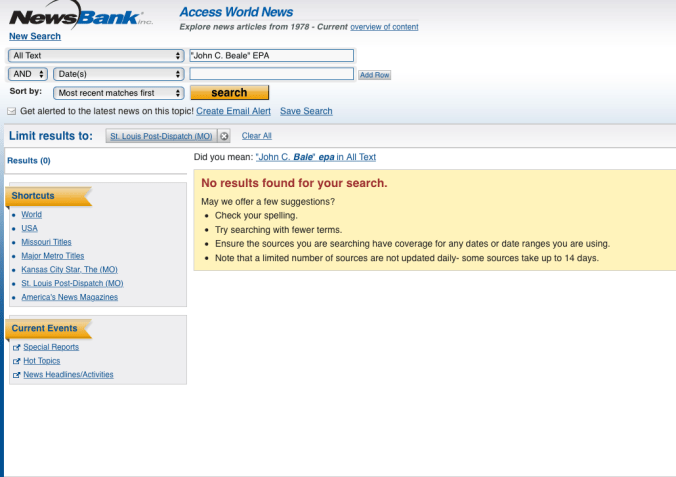
When self-professed CIA agent John C. Beale left the halfway house in Philadelphia on June 1, his unheralded release marked the end of a bizarre saga that began quietly in 2000. For the next 13 years, under both Republican and Democratic administrations, Beale told his EPA colleagues that he worked for the CIA.  Finally, when confronted about his alleged covert activities in 2013, Beale claimed he had fabricated his espionage career to get out of work. By this point he had reportedly fleeced the government out of $866,168 in travel expenses, bonuses and compensation. He pleaded guilty of felony theft charges, promptly paid a seven-figure fine and was sentenced to 32-months in federal prison.

Beale served only 18 months before he walked, a veritable slap on the wrist for the crime to which he confessed.  But his boss, EPA administrator Gina McCarthy,  to whom Beale reported, survived the scandal unscathed and was actually promoted to head the agency in the wake of the controversy.

The press had a field day with the Beale affair. C-Span covered the resulting congressional hearings. NBC and the Washington Post reported the story,  as did various online publications and the Associated Press. Wire service coverage appeared in nearly 100 newspapers coast-to-coast. Newspapers that reported the story included the Albuquerque Journal, Pittsburgh Post-Gazette, Iowa City Press-Citizen, Great Falls Tribune, Baxter Bulletin and the Poughkeepsie Journal.

In St. Louis, however, the whole sordid affair went unreported because the The St. Louis-Post-Dispatch failed to mention Beale’s misdeeds.

A significant story involving corruption at the highest levels of a federal agency  were overlooked. An entire metropolitan region  left uninformed by its only major daily newspaper, hundreds of thousands of readers kept in the dark.

For St. Louisans, it was as if the Beale affair never happened.

The lack of coverage by the Post-Dispatch was even more egregious because of the EPA’s mishandling of the West Lake Landfill clean up in St. Louis County.

screen-shot-2016-10-05-at-09-13-41

Radioactive waste from the Manhattan Project and Cold War era had been illegally dumped at the West Lake Landfill in 1973. The EPA had taken over the Superfund site in 1990. But by 2013, the agency had yet to clean up the mess, and the natives were getting restless. Thanks to social media,  a community group dedicated to the issue, STL Just Moms, grew by leaps and bounds. Among its primary goals:  the protection of human health and the removal of the waste from the Missouri River floodplain. Another of the organization’s main objectives is to ditch the EPA altogether and hand over the clean up to the U.S. Army Corps of Engineers.

While the local outrage ramped up here, corruption charges were being leveled against top EPA officials implicated in the  Beale affair.  But in St. Louis few people knew about the agency’s troubles in Washington because of the local news blackout.

screen-shot-2016-10-05-at-09-26-15

In the nation’s capital, it was a big story. The U.S. Senate and House of Representatives took a keen interest in the Beale’s shenanigans and lambasted EPA administrator McCarthy for her involvement.  On October 1, 2013,  for example, Beale himself  was grilled  before the House Committee on Oversight and Reform for hours. His written statement is 263-pages long.

Nevertheless, a blanket of censorship remained in place in St. Louis.

“The name is Beale, John Beale.”

Beale had started working at the EPA in 1988 and was soon elevated to the position of policy analyst. His areas of expertise included the Clean Air Act and climate change. In 2000, he began taking days off of work to allegedly attend CIA meetings. Over the course of the next decade his absences increased. By 2008, his days off increased dramatically, when he requested and received a six month hiatus to ostensibly take part in a CIA covert operation. After the Obama administration came into power in 2009, McCarthy became Beale’s boss in the EPA’s Office of Air and Radiation, and his role as the EPA’s secret agent continued uninterrupted. She didn’t question his alleged CIA ties. If anything, she accepted the idea without reservation.

In September 2011, Beale and two other EPA officials threw a retirement party for themselves on a yacht in the Potomac River. EPA Administrator Gina McCarthy attended the shindig. She considered Beale to be one of her most competent managers. At the same time, she  was also aware of his alleged dual role as a CIA agent, but, nevertheless, lamented Beale’s  departure from the EPA. None of this raised any red flags for a long, long time.

But the saga gets weirder. Beale officially retired in early 2012 but he inexplicably continued to receive his full salary after his retirement. By this time, Beale’s paycheck, which included bogus bonuses, exceeded McCarthy’s  salary. He was the highest paid employee at the EPA and he wasn’t even showing up for work. Beale was pulling down a full-time salary of $206,000 from the EPA — after he had retired.

under the guise of national security

screen-shot-2016-10-05-at-09-17-10

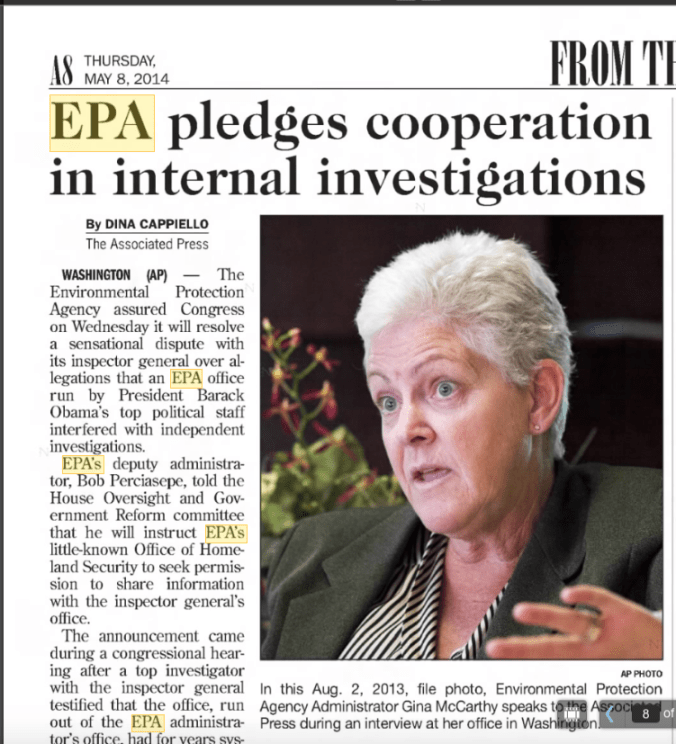
When the EPA Office of Inspector General began investigating Beale, its probe was upended by a little-known subunit within EPA administrator Gina McCarthy’s inner sanctum. McCarthy’s chief of staff was in charge of the obscure detachment, which calls itself the EPA Office of Homeland Security.

This  questionable operation is not part of the Department of Homeland Security and was run without oversight, after being set up in 2003 to deal with possible terrorism threats against sensitive environmental sites. Its intended purpose was to coordinate protocol with the FBI. It has no statutory authority to conduct internal investigations. But that’s exactly what it did in John C. Beale’s case, much to consternation of the EPA Office of Inspector General.

Testifying before the same congressional panel that Beale appeared before, Assistant EPA Inspector General Patrick Sullivan said that the investigation of John Beale had been  obstructed because Beale had been tipped off that he was a subject of interest by McCarthy’s sketchy security apparatus run out her office and headed by Gwendolyn Keyes Fleming, the administrator’s handpicked chief of staff.

“The OHS’ actions, which included several interviews with Mr. Beale, damaged the OIG’s subsequent investigation,” Sullivan told Congress.

McCarthy was far from the only one who believed Beale was a CIA agent. Some of Beale’s colleagues at the EPA still remain convinced that he was a covert operative. Moreover, Beale’s wife was under the assumption that her husband worked clandestinely for the CIA since 1994.

Nancy Kete, Beale’s spouse, met him when she was employed by the EPA. She took a sabbatical from her EPA duties in the early 1990s to work in Paris as an environmental advisor for the Office of Economic Cooperation and Development, an organization that grew out of the Marshall Plan, the United States government’s efforts to rebuild Europe after World War II. By the time the scandal broke in 2012, Kete had made a career change and was the managing director of the Rockefeller Foundation, a position she held until this April.

screen-shot-2016-10-07-at-16-30-54

Kete’s credentials suggest that her professional ties may connect her more to the shadowy world of espionage than her husband’s career path. She reputedly was embarrassed by the exposure that her husband’s escapades received.

Under existing federal law, the CIA must inform other U.S. government agencies if any of its employees also work for the agency. When contacted, the CIA denied any association with Beale.

For his part, Beale expressed contrition for his lies, paid his fine of more than $1.3 million and served his time. In the wake of the scandal, Gina McCarthy was promoted to head the EPA.  The story that wasn’t reported in the St. Louis Post-Dispatch has now been largely forgotten by the rest of America, too.

No progress has been made in cleaning up the  EPA’s West Lake Landfill Superfund site, as a change in presidential administrations nears. The stonewalling and the foot dragging  will likely continue into the next year.

Meanwhile, community activists in St. Louis are continuing to expose the shameful betrayal perpetrated by the U.S. government against its citizens despite lax coverage by the local news media.

Casual readers of spy thrillers are aware that it is standard operating procedure for the CIA to deny involvement when any of its covert actions are publicly exposed. It appears that the EPA operates on the same principle.

John C. Beale may now be long gone, but the game goes on.

screen-shot-2016-10-05-at-08-55-37

Behind Closed Doors

While the underground fire continues to burn at the radioactively-contaminated West Lake Landfill, the federal government seems more concerned about quietly hashing out deals with corporate interests. 

screen-shot-2016-10-01-at-10-02-18

Attend any West Lake Community Advisory Group meeting and you’ll see them there. They’ll be scribbling notes. More often than not, they’re well-dressed women in business suits, serious professionals. But they’re not government officials, scientists, or engineers.

They’re lawyers. Private lawyers.

The attorneys are quietly noting every detail being discussed at the public forums so they can report back to their corporate clients. They are the hired guns of the potentially responsible parties, those companies held liable under the EPA Superfund law for the cost of the  West Lake Landfill clean up. Except for these rare appearances, the lawyers mostly work behind the scenes, with little or no accountability to the public.

It’s not unusual for private attorneys to meet on the low, but in this case their talks are being  facilitated by the Department of Justice. Involvement of the DOJ, which is keeping an unusually low profile, raises more questions about the situation at West Lake, which is already mired by doubts and suspicions due to a lack of transparency by government regulators.

While the lawyers meet behind closed doors, an underground landfill fire is approaching the radioactive waste at the site, exposing residents to unknown risks.

The three potentially responsible parties that share the liability for the clean up of the site are the U.S. Department of Energy,  Exelon Corp., and Republic Services, owner of the troubled dump.

DOJ’s involvement isn’t new. It’s been going on a long time, sanctioned by obscure federal rules and regulations and codified by law.  But few people in the impacted community of North St. Louis County are aware of the DOJ’s influence.

After the Nuclear Regulatory Commission handed over control of the site to the EPA decades ago, the DOJ stepped in to act as an arbiter among the potentially liable parties [PRPs], negotiating the terms of a settlement agreement, a pact which is referred to as a “non-binding allocation of responsibilities.” In short, the deal specifies who pays for what.

The quiet DOJ negotiations  would have remained so if not for efforts of environmentalists intent on uncovering the tangled relationships among government regulators and private industry. The revelation was exposed by the recent release of internal EPA email records obtained by the Environmental Archives under the Freedom of Information Act. One of the emails references DOJ’s role.

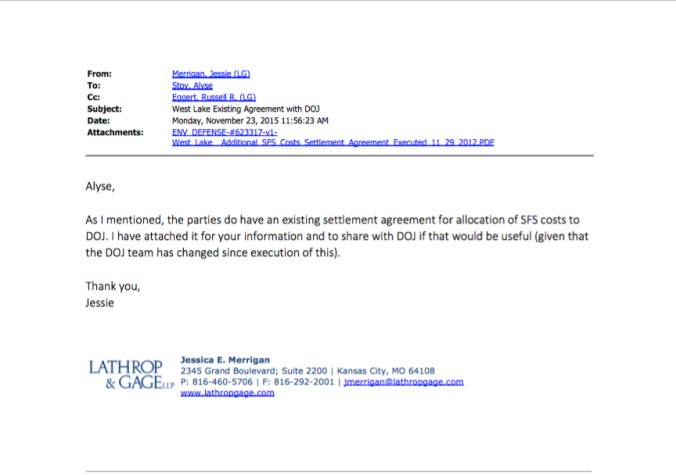
On Nov. 23, 2015, Jessie Kerrigan of Lathrop and Gage law firm wrote to Alyse Stoy, EPA Region 7 general counsel:

“As I mentioned the parties do have an existing settlement agreement for allocation of SFS costs to DOJ. I have attached it for your information and to share with DOJ if that would be useful (given that the DOJ team has changed since the execution of this).”

Lathrop and Gage represents  Republic Services, one of the PRPs.  SFS stands for “supplemental feasibility study.” The supplemental feasibility study is being done as a part of reconsidering the EPA’s 2008 Record of Decision.

The message is vague but indicates that DOJ’s current role goes beyond being a mere negotiator. Instead, the email suggests that the DOJ is paying the cost of the supplemental feasibility study or  playing the role of  the EPA’s collection agent. But just how much money is being paid out by whom and for what purposes is unclear because DOJ’s books are closed.


Rocky Top

Home values in Spanish Village may have declined due to its proximity to the stinking West Lake Landfill. But besieged subdivision dwellers also live on top of a limestone deposit worth a fortune.
screen-shot-2016-03-14-at-7-01-37-pm

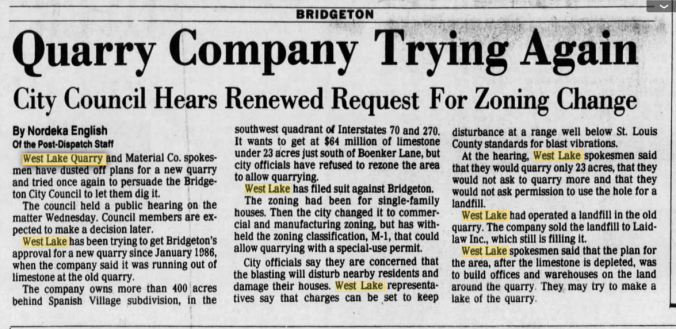
In 1986, the West Lake Quarry and Material Company sought to expand its quarry operations to an adjacent hillside next to Spanish Village subdivision, thereby gaining access to valuable limestone deposits. The city of Bridgeton nixed the proposal.

The ranch-style homes in the Spanish Village subdivision are reminiscent of the not-so-distant past, an idyllic reflection of the 20th Century in our collective rear-view mirror.  Driving by the neatly  trimmed lawns there is no clue that the Bridgeton city park at the end of a cul de sac was once owned by the West Lake Quarry or that it is potentially contaminated with radioactive waste. There’s no hint of the valuable natural resources that lie beneath the surface, either.

Some older residents may remember the park deal that was hashed out in the 1970s by the city council and the then-landfill owners. Records of the sale are buried in the Bridgeton Council minutes. The memory also may lingers the minds of a few present and former locally elected officials.

But they’re not talking.

Talking is something that comes naturally to trial lawyers, however, and, in the summer of 2014, personal injury attorney Daniel P. Finney held court under the eaves of the park pavillion.  A midday thunderstorm rumbled over the hill, but the lawyer didn’t pause. The ensuing rain, offered him a captive audience under the shelter.

As the rain poured down, the lawyer made his best case for signing up with his law firm. He was forthright in his pleadings and offered no promises. He understood the difficulty of proving that radioactive and chemical contaminants from the nearby West Lake landfill had effected the subdivision residents’ health.

Last week, 34 residents, who signed with Finney, reached an out-of-court settlement with a subsidiary of Republic Services, the current owner of the West Lake Landfill Superfund site, where radioactive waste was dumped in 1973. The lawsuit compensates homeowners for their exposure to noxious odors due to an underground fire at the landfill. Terms of the agreement were not made public, but the settlement likely denies the plaintiffs any future redress of grievances.

Those who didn’t take part in the lawsuit remain in limbo. One of the obvious negotiating issues for the Spanish Village property owners is their individual home values, which is based on comparable residential real estate in St. Louis County. The toxic odors wafting from the landfill have decreased home values in the subdivision.

But there is an added value to their property that isn’t being considered. The missing factor in the property evaluation is that the houses are built on top of a precious natural resource — limestone.

The landfill itself, after all, is located at the site of a former quarry, which sits on the edge of the Missouri River flood plain.  Past owners of the landfill founded their business on the presence of the abundant limestone deposits, which are an essential commodity of the construction trade.  In a nutshell, they dug huge holes in the ground to mine and sell the rock deposits and then made more money by charging waste haulers to fill the excavations with all manner of trash, including toxic nuclear and chemical pollutants. The resulting contamination is now leaking into the groundwater.

The EPA has announced it will make its final decision on the clean up plan for West Lake by the end of the year. Under the EPA’s guidelines, there are three proposed alternatives: capping the waste and leaving it in place; excavating and removing it; or a compromise solution that involves a partial excavation. All three alternatives will require massive amounts of  limestone rock materials in one form or another. Transporting the rock from other quarries would be a time consuming and expensive operation.

But there is another option. The nearest limestone deposits to West Lake Landfill are on the adjacent hillside — the location of the Spanish Village subdivision.

The public, including some residents of the subdivision, may not be aware of the limestone deposits, but it is not a secret to state and federal agencies. The U.S. Geological Survey is aware of the limestone deposits because they surveyed the area decades ago. USGS’s counterpart, the Missouri Geological Survey, mapped the area to ascertain the location of mineral deposits in the area. So they know about the location and value of the deposits, too. Moreover, the Missouri Geological Survey is an arm of the Missouri Department of Natural Resources, which is responsible for monitoring the underground fire that is burning at the Superfund site.

There is evidence that that the landfill owners in the past have also been aware of the value of the nearby limestone. That’s because they asked the city of Bridgeton to rezone part of the adjacent hill so it could be quarried more than 30 years ago.

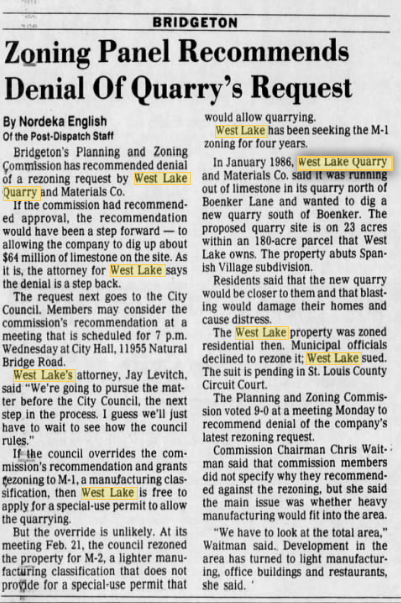
In 1986, West Lake Quarry and Materials Co. asked permission from the city of Bridgeton to expand its quarry operations south of Boenker Lane on 23-acres of a 180-acre tract of land it owned — which abuts Spanish Village. The monetary value of the limestone deposits at the site were estimated in 1986 to be worth $64 million. The Bridgeton Planning and Zoning Commission denied the request.

The  value of the limestone deposits in 2016 would obviously be far greater because of its proximity to the Superfund site. It’s a matter of supply and demand. In short, whoever is contracted to remediate the contaminated landfill by the government is going to need large quantities of limestone rock, gravel and cement.

The radioactive waste at West Lake Landfill was first generated as a part of the Manhattan Engineering District’s secret project to build an atomic bomb. The uranium was processed in St. Louis under a classified contract between the U.S. Army Corps of Engineers and  the Mallinckrodt Chemical Works.

The Manhattan Project was born in secrecy and secrecy remains a constant variable in the 70-year-old saga. There is every reason for this dire situation to be handled with expediency. But history tells us that timely action has never been part of this catastrophe’s chronology.

Openness would offset the doubts and fears that besiege the residents of Bridgeton and the entire region. Instead, negotiations concerning this eminent public health threat are far too often still conducted behind closed doors. Deals are struck, moneyed interests placated.

The trash company liable for this mess bears a name and a logo that evokes patriotism. Its shiny blue trucks lumber through our neighborhoods.  Other responsible parties include Chicago’s electric utility company and the Department of Energy, the successor to the Atomic Energy Commission, which was spawned by the Manhattan Project. This trio’s  combined lobbying power extends from City Hall to the White House.

To believe that they will do the right thing of their own volition is like the proverbial frog  trusting the scorpion to act against its predatory instincts. As the compromises are hashed out and alliances shift, lawyers will continue to talk,  politicians will keep making deals, and the free marketeers will line up once again to feed at the trough.

None of these machinations confront the dangers posed by the nuclear waste that is hitching a ride with fire, wind and rain. Nature is undeterred by human folly. Frankly, it doesn’t give a damn.
screen-shot-2016-03-14-at-6-57-58-pm


Equally obscured by the carefully landscaped yards is the interest that the Missouri Geological Survey had in the area back in the late 1980s, when the agency partially redrew its maps to better understand the composition of natural resources that lie beneath the surface. Understanding the area’s geology of the nearby hills and  adjacent Missouri River flood plain is driven as much by commerce as science.

That’s because the underground karst topography is composed  deposits of limestone, a valuable commodity used for various construction purposes, including levees, roads and home construction.

Residents of Spanish Village nowadays are more concerned about the stench of toxic chemicals whaffing from the nearby West Lake Superfund site, which


ecades ago the Missouri Geological Survey took an interest in the area for reasons other than


New Effort Planned To Get Quarry OK’d

St. Louis Post-Dispatch (MO) (Published as St. Louis Post-Dispatch) – February 26, 1990Browse Issues

The Bridgeton City Council has rezoned about 173 acres near the Spanish Village subdivision so that the land owner, West Lake Cos., can build a factory. But that’s not what West Lake wants.

The company has applied for rezoning that would allow quarrying. The city’s Planning and Zoning Commission is expected to make a recommendation on that matter at a meeting scheduled for 7:30 tonight at Bridgeton City Hall, 11955 Natural Bridge Road.

The company wants to quarry the limestone that lies just under the dirt on the ridge. Company officials say that a 20-year supply, with a value estimated at $64 million, is sitting there. The company has been trying for four years to get at it.

The council rezoned the land at a meeting Wednesday. This was the latest move in a series of rezonings, driven by court rulings since 1986.

West Lake Cos. is owned by the Archdiocese of St. Louis, the Shrine of St. Jude and the Propagation of Faith.

The company owned and operated West Lake Landfill nearby until l988, when Laidlaw Waste Systems bought it. But West Lake Cos. retained ownership of the remainder of the land.

In late 1985, West Lake Cos. determined that it was running out of rock at its quarry north of Boenker Lane and applied to Bridgeton to dig a new quarry south of Boenker. The landfill is operating in the depleted quarry hole.

The land where West Lake wanted the new quarry was zoned for single-family houses. Rezoning was required.

But the landfill and quarry and the potential quarry are situated behind Spanish Village subdivision. Residents there adamantly opposed a new quarry. They said that blasting at the old quarry had shaken their houses and caused them distress.

West Lake officials said that if they didn’t open the new quarry, they would have to lay off most of their workers at the company’s plants nearby.

At one point, the City Council got a petition signed by 125 Spanish Village residents in protest against the proposal for a new quarry and a petition signed by 114 West Lake employees in favor of it.

The City Council declined to change the zoning. West Lake sued. A judge ordered Bridgeton to find a more reasonable zoning than residential for the property. Bridgeton rezoned it to B-5, planned commercial, and M-3, planned manufacturing. Offices could be built in both zoning classifications.

But West Lake pressed the matter in court.

Bridgeton had an M-2 manufacturing classification that would have allowed quarrying with a special-use permit. The city removed the quarrying provision from the M-2 classification. And M-2 is what the council rezoned the area to on Wednesday.

But West Lake has applied to the city for M-1, manufacturing zoning, the only zoning classification that allows quarrying, with a special-use permit. The Planning and Zoning Commission held a hearing on the rezoning at a meeting Feb. 12 and may make a recommendation at tonight’s meeting.

If the council agrees to rezone the area for M-1, then the commission may take up the matter of the special-use permit.

A Longstanding Relationship

Five years after B&K Construction illegally dumped Cotter Corp.’s radioactive waste at the West Lake Landfill, the two companies continued doing dirty business with each other. 

screen-shot-2016-09-26-at-19-33-32

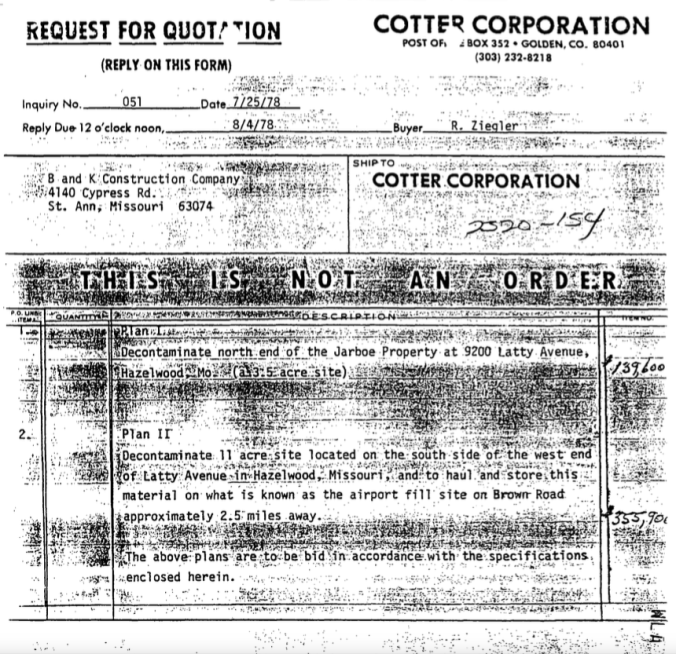
In July 1978, Cotter Corp., the owner of the radioactively-contaminated site on Latty Avenue, solicited a bid from  B&K Construction to “decontaminate” 14.5 acres at the location in Hazelwood. B&K proposed doing the job for more than $492,000, according to a company record made public today by the Environmental Archives.

Five years earlier, in 1973, B&K had dumped radioactive waste belonging to Cotter at the West Lake Landfill in Bridgeton. The EPA Superfund site has yet to be cleaned up.

Cotter’s proposal was broken into two parts. B&K offered to remediate the  north end of the 3.5-acre Jarboe Property at 9200 Latty Avenue for $139,900,  and bid more than $355,900 to clean up 11 acres at Cotter’s property next door.

The proposal called for hauling the radioactive waste materials back to the 22-acre airport site, where they had originally been stored years earlier.

An investigation by the Atomic Energy Commission discovered the illegal dumping at West Lake in 1974. Though the AEC found violations of its regulations had occurred, neither company was held accountable for its actions.


Double Trouble

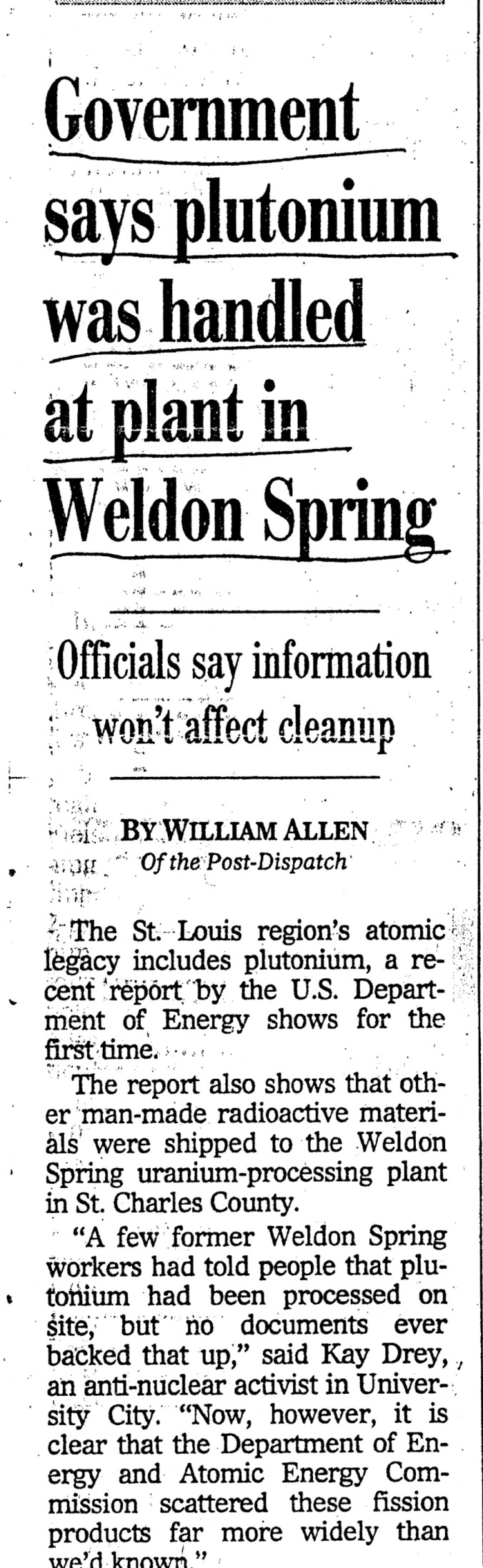
The presence here of plutonium — the most toxic of radio isotopes — is attributed to two sources. Finding either one is like looking for a needle in a haystack.  

plutonium-1

The Department of Energy doesn’t know where the plutonium is.

In March 2001, the DOE reported that the nuclear facility in Weldon Spring handled recycled uranium for years.  DOE investigators reported that 70,000 metric tons of recycled uranium passed through the plant between 1957 and 1966, when the Mallinckrodt Chemical ran the operation for the Atomic Energy Commission. The investigation calculated that 2.4 grams of plutonium would have present in this amount.

Recycled uranium is hotter because it has been irradiated in a nuclear reactor. At the time, it was estimated that exposure to one-millionth of an ounce of plutonium could cause cancer.

But the recycled uranium may not be the only source of potential plutonium contamination in the St. Louis region.

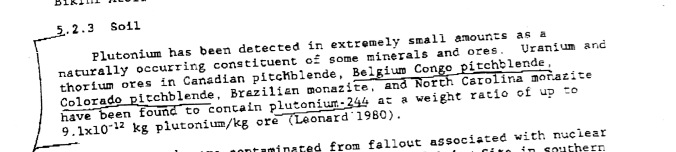
That’s because the Belgian Congo pitchblende that Mallinckrodt processed to make the first atomic bombs contains small amounts of plutonium, according to the Agency for Toxic Substance and Disease Registry.

plutonium-5

Waste byproducts from the pitchblende processing is known to have contaminated a several sites in the St. Louis area, including Coldwater Creek and West Lake Landfill.


Every Move You Make

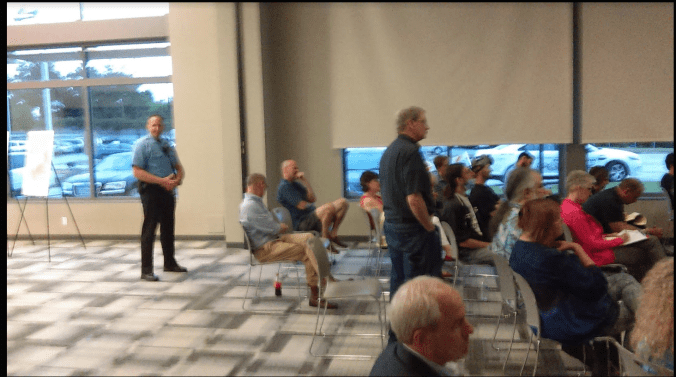
The EPA invited concerned citizens to meet with agency officials on August 15 to discuss the West Lake Landfill and then surreptitiously  photographed attendees.

screen-shot-2016-09-23-at-18-36-43

EPA Region 7 public affairs specialist Kris Lancaster is seated  with his head turned to avert being photographed. Lancaster was assigned to snap photos of those who attended the meeting at the Bridgeton Recreational Center, but he was camera shy himself.


A cast of 50 to 75 community members took part in the performance, which was carefully scripted and managed by an EPA consultant  who had flown into St. Louis from New England for the event. A New York filmmaker also parachuted in.

Some of young protestors came in costume, wearing surgical and gas masks. They politely waited to hold their die-in until after the old folks were done talking.  The remainder of the audience was comprised of suburban householders, old-school environmentalists,  politicians, and the odd reporter.

The scene had all the markings of a summertime reality TV show, including more than one camera.

On cue, the program  started  at 6:00 p.m. on August 15 at the Bridgeton Recreational Center and ended two hours later, when the young protestors staged their protest.

Everyone was there to participate in a community dialogue with EPA officials about whether radioactive waste at the West Lake Landfill Superfund site should be excavated and hauled away from the Missouri River flood plain and disposed of elsewhere, or capped in place and left to leak into the underground water system forever.

The choice couldn’t seem more clear. By holding the meeting, it makes the insane option #2 seem more acceptable. This, of course, is the EPA consultant’s job, making the implausible plausible.

The EPA officials listened to the reasoned pleas of the citizens, hemmed and hawed, and waited for the clock to run out, which seems to fit their overall strategy. The federal agency first proposed leaving the waste in place back in 2008, but the idea met stiff community opposition, which forced the EPA to take a second look at other options. A final record of decision on what to do with the long-neglected site is slotted for the end of the year.

With the deadline approaching, the angst in the room was palpable.

Community activists have been lobbying for years to have the clean-up taken away from the EPA and put in the hands of the U.S. Army Corps of Engineers, which has cleaned up similar waste in the St. Louis area under the aegis of the Department of Energy’s Formerly Utilized Site Remedial Action Program or FUSRAP. But the bill authorizing that change up is stalled in Congress.  During the lull, the EPA is moving ahead with its plan, which has been further complicated by an underground landfill fire at the site.

Add the potentially responsible parties, including the DOE and a couple of heavy-hitting corporations along with a confusing mash up of  various political interests, and it makes for a disaster that is not waiting to happen, but rather unfolding in real time.

There’s also the aforementioned edgy feeling to these events.

The EPA’s stage-managed productions may be formulaic,  but there’s always the chance that someone will go off script. EPA officials cancelled their appearance at a meeting this spring, for example, after a threat was made against them on Facebook.

Maybe that’s why the anonymous man in the blue shirt and khaki pants sat quietly in the back of the room snapping pictures of those in attendance on August 15.

When later cornered, he gave his name, rank and serial number.

EPA Region 7 public affairs specialist Kris Lancaster said he was there to assist his fellow flack Ben Washburn. Lancaster said his role for the evening was to take photographs for the EPA’s newsletter, but he wasn’t sure how many of them they would use.

Lancaster has bounced around the federal bureaucracy a long time, previously doing stints with the U.S. Army Corps of Engineers and the U.S. Department Health Human Services. He has also served as a congressional aide twice during his career. Between 1990 and 1993 he held a staff position with U.S. Rep. Thomas Coleman of Kansas City. Lancaster started his career in 1975 as an aide to U.S. Rep. Richard H. Ichord of southeast Missouri.

screen-shot-2016-08-17-at-20-35-43

screen-shot-2016-09-23-at-20-35-59

Ichord is most remembered for being the last chairman of the House Un-American Activities Committee, which was renamed the House Internal Security Committee during his tenure that ran from 1969 to 1975.

In a 1970 speech before the St. Louis County Chamber of Commerce, Ichord, a zealous anti-communist, warned that the environmental movement could someday be subverted by the radical left.

Speaking at Slay’s restaurant in Affton, the congressman said, “Solving the problems of pollution will require sound and pragmatic actions from state and city governments, plus massive volunteer activities as well as the support you have the right to expect from the federal government.”

Apparently, taking surveillance photos at public meetings is part of the federal government’s responsibilities — and  Dick Ichord’s man is still on the job — 40 years later.

screen-shot-2016-09-23-at-18-36-43


Out of Sight, Out of Mind

Documents show toxic leachate from West Lake Landfill was dumped in the Mississippi River for decades. 

screen-shot-2016-09-22-at-09-56-01

Until last year, Republic Services, the owner of the troubled West Lake Landfill in Bridgeton, Mo., shipped as many as 200 truckloads of toxic leachate  daily to the Metropolitan Sewer District’s Bissell Point treatment plant on the Mississippi River.

The shipments stopped in April 2015 after the completion of  a 7.2 mile pipeline that links the landfill with the MSD treatment plant in north St. Louis. The pipeline project corresponds with other belated measures taken by the landfill owner and the sewer district to control an estimated 300,000 gallons of noxious liquid produced at the site each each day. The increased levels of leachate are in part due to the underground fire burning at the EPA Superfund site, which is moving dangerously close to nearby radioactive waste.

In 2013, MSD refused to accept leachate from the landfill for several months because it contained high levels of benzene, a known carcinogen. This forced Republic to dispose of the toxic shipments elsewhere.

Odor complaints against the landfill have risen dramatically in recent years due to the underground fire, at the same time public concerns increased due to concerns over the radioactive waste, which is known to have migrated off site and contaminated the groundwater. The landfill is located in a flood plain about one mile from the Missouri River.

Hauling the the West Lake leachate from the site and dumping it into the Mississippi River didn’t develop overnight, however. It’s been going on for more than 35 years, according to the Missouri Department of Natural Resources.

MDNR records recently released to the Environmental Archives under the Freedom of Information Act indicate leachate was hauled from West Lake to Bissell Point on a daily basis as far back as 1980. The state regulatory agency calculated that an estimated 48,000 gallons was removed from the landfill daily and ultimately released into the Mississippi River.

Prior to last year, the landfill’s leachate operation did not have an onsite treatment plant. The stringency of MSD’s treatment process in the past remains uncertain. It is unclear whether the radioactive materials in the leachate were monitored before disposing of the shipments in the river.


Was West Lake Landfill a Nuke Dump Before 1973?

screen-shot-2016-09-16-at-21-54-53

A 1981 report prepared for the Nuclear Regulatory Agency raises more questions about the origins of the radioactive waste at the controversial  West Lake Landfill Superfund site, including who dumped it and when.

No doubt exists that B&K Construction Co. hauled more than 40,000 tons of radioactive material from Cotter Corp.’s  Latty Avenue storage site in Hazelwood, Mo. and illegally dumped it at the West Lake Landfill in Bridgeton, Mo. between July and October of 1973.

But a 1981 government report obtained by the Environmental Archives now suggests some of the nuclear weapons waste at the landfill was quietly disposed of years earlier. Forty-five years later it remains a mystery where the latter nuke waste originated or who dumped it

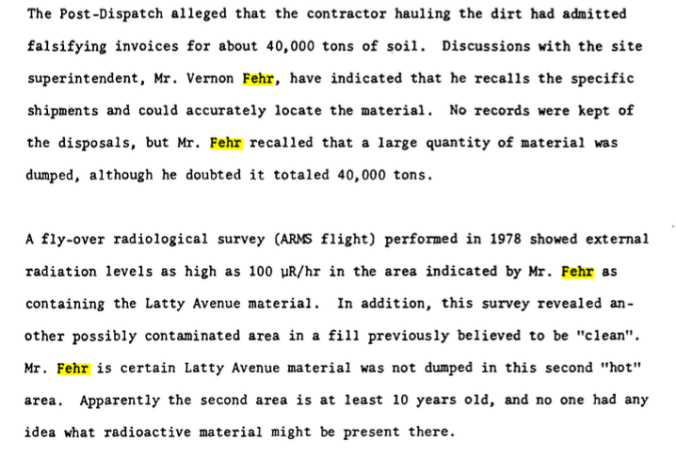
The report, released under the Freedom of Information Act, is based on a 1980 site investigation by the Radiation Management Corp., a Nuclear Regulatory Commission contractor. The report states that the then-landfill superintendent recalled with certainty that the Latty Avenue waste was disposed on approximately two acres in the southern portion of the landfill.

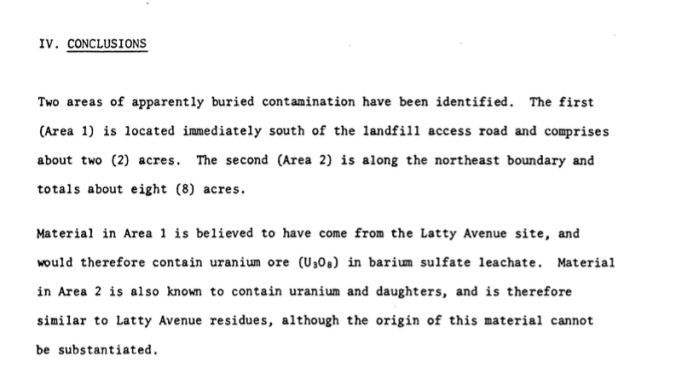
Vernon Fehr, the superintendent who had first-hand knowledge of the landfill operations for the time periods in question, also said with certainty  that none of the radioactive materials from Latty Avenue  were dumped in the other contaminated part of the landfill, which is comprised of approximately 8 acres in the northeast section.

The NRC report states, “the second area is at least 10 years old (in 1981), and no one had any idea what radioactive material might be present there.” If that timeline is correct, it means large volumes of radioactive waste were secretly dumped at the landfill at least two years prior to  B&K arriving on the scene.


screen-shot-2016-09-17-at-19-05-48

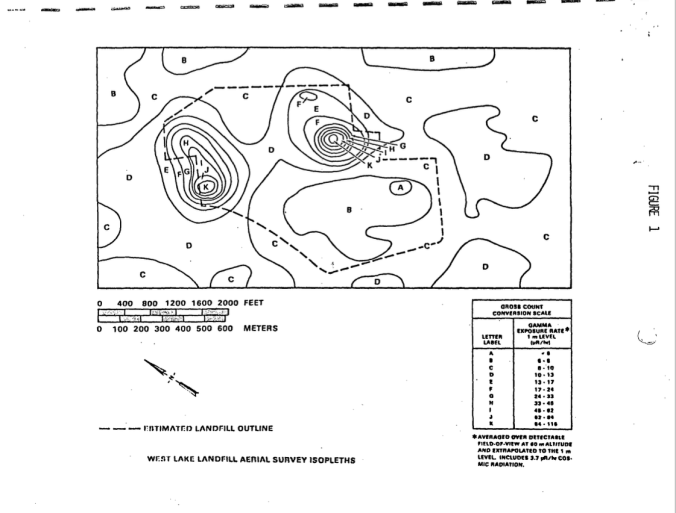
Radiation Management based its findings on both the landfill manager’s testimony and a 1978 aerial survey of the landfill by EG&G engineering firm. The aerial survey discovered radioactive contamination above background on  2.6 acres acres in the southern part of the landfill and also present on  8 acres in the northeast portion of the site.

screen-shot-2016-09-17-at-19-30-02

Current attention has been directed mainly at area of the landfill nearest the underground fire, which is burning at the adjacent Bridgeton Landfill.

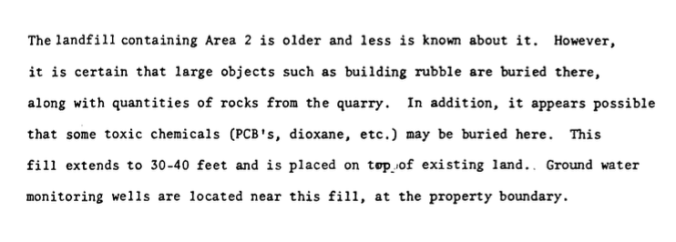
The eight acres in the northeast sector of the site include a toxic stew of chemical waste in addition to the radioactive materials. The mixed contaminants are known to be migrating off site and leaking into the aquifer. The landfill is in the flood plain, approximately 1.5 miles away from the Missouri River.

The exact nature of the all radioactively-contaminated materials and their precise locations remains uncertain because the EPA has failed to fully characterize the site since taking over the clean up in 1990.  In short, despite untold numbers of various tests and surveys over the years,  a comprehensive grid test of the entire 200-acre Superfund site has never been conducted.

screen-shot-2016-09-17-at-19-40-08


Tom Slick’s Legacy

When the EPA trumpeted the findings of the Southwest Research Institute earlier this year,  it didn’t mention the founder’s quest for Yeti or his ties to the CIA. 

tom_slick-2-231x300

In July, EPA Region VII announced that the prestigious Southwest Research Institute in San Antonio had analyzed soil samples from West Lake Landfill and found that heating  dirt from the radioactively-contaminated dump in a laboratory setting had not increased dangerous radon levels.

Community activists were not assured by the pronouncement, however. They are still demanding an expedited cleanup of the long neglected site in North St. Louis County and continue to question attempts by the press and the EPA to downplay the problem posed by the nuclear weapons waste.

For its part, the EPA  has cast the debate as one that pits the dismissive opinions of its so-called scientific experts against the public’s perception of risk, which they contend is based on rumors and misinformation.

A good argument could be made, however, that rumors and misinformation is the stuff from which the Southwest Research Institute spawned.

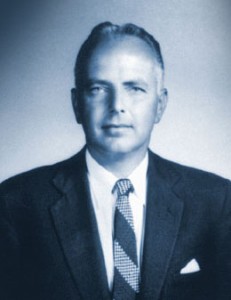
The late Tom Slick Jr.,  founder of the Southwest Research Institute, believed in the existence of the Yeti, aka, the abominable snowman; and he spent a considerable amount of time and money attempting to prove the creature was a reality.

You read correctly: One of the top government-approved research facilities in the country, with a revenue exceeding $500 million in 2015, was established by a bonafide cryptozoologist, a true believer, who spent years chasing after the abominable snowman, the subject of derision among generations of serious scientists who scoff at the idea and label it nothing more than pure science fiction.

It’s enough to give pause, when the EPA asserts that its contractors hold a monopoly on  irrefutable scientific facts.

But there’s more.

When he wasn’t chasing Bigfoot or giant Alpine salamanders, Slick operated a CIA air cargo company in his spare time, while managing his oil and cattle empire.

Apparently, the same curiosity and fervid imagination that fueled his search for monsters drove him to start up the research center in 1947. He subsequently bankrolled two expeditions to the Himalayan Mountains of Tibet in search of the legendary, hirsute biped.

The Tom Slick Foundation still helps support the Southwest Research Institute.

Slick also endowed the Tom Slick Professorship of World Peace at the University of Texas, where former EPA Region 7 administrator Karl Brooks now teaches.

Slick also went on a trek to the Canadian Northwest in search of the Yeti’s North American cousin, Bigfoot. Before either of these quests, Slick, while still in college at Yale,  journeyed to Scotland to investigate the legendary Loch Ness monster.

Slick inherited his wealth from his father, a wildcatter who struck black gold during the Oklahoma oil rush of the 1920s.

In the 1950s, Slick and his brother operated Slick Airways, a CIA air cargo company that operated in Asia before the notorious Air America of the Vietnam era.

There is speculation that Slick’s Tibetan expeditions were covers for covert CIA operations to gather intelligence on Chinese hegemony in the region.

His friends and associates included eccentric billionaire Howard Hughes and Hollywood actor Jimmy Stewart.

Slick, an avid pilot, died when his small plane crashed on a return flight from a Canadian hunting trip. He was 46 years old.

A planned feature film, Tom Slick, Mystery Hunter, starring Nicholas Cage was shelved in the 1990s.